Introduction: Beyond the Hype of AI Generation
Fifty-one percent of spam emails in early 2025 showed signs of AI use, according to Columbia Engineering research. This massive wave of automated text forces publishers to ask a critical question: does google penalize ai content? Many brand managers worry about automated penalties. However, Google’s official stance clarifies that appropriate use of AI or automation is not against search guidelines, provided it is not used primarily to manipulate search rankings (Source: Google Search Central Blog). The system targets scaled content abuse rather than the software itself. Smart operators use strict quality gates to survive.
Systematic quality control prevents rapid content decay. Rankability SEO Study reveals that Google’s ranking algorithms do not penalize AI-generated content based on its origin, but are designed to filter out low-quality, unhelpful, or machine-written text. To measure search engine performance under this new reality, Google updated its Search Quality Rater Guidelines in January 2025, expanding the evaluation document from 170 pages to 181 pages (Source: Search Engine Roundtable). Success requires a reliable site operator. Publishers must upgrade their systems to meet these rising standards.
The Illusion of AI Detection and ‘Humanization’
Building on this systematic quality control, publishers often ask: does google penalize ai content? Many search operators turn to AI detectors, but these tools offer a false sense of security. GPTZero notes that detectors merely analyze wording, rhythm, predictability, and structural consistency to estimate machine-generation likelihood.
Unfortunately, detection accuracy is incredibly low. Quora reports that scientific testing reveals detectors have low overall accuracy rates, averaging between 39.5% and 60% in identifying AI text.
Can humans spot the difference? Penn State University research shows humans distinguish AI-generated text from human writing only 53% of the time, which is barely better than random guessing.
Trying to bypass these systems is equally flawed. * Modern humanizers rewrite machine text to improve flow and bypass detection, with platforms like HIX Bypass claiming high success rates (Source: Grammarly). * This practice of “humanizing” misses the mark on actual quality. * True validation requires a deeper analysis.
To verify content origin, the Reddit BypassAIDetector community suggests modern workflows use AI detectors alongside plagiarism checks, citation analysis, and writing history signals. Security comes from proof, not trickery. This shift in validation methods directly changes how publishers must structure their content production systems going forward.
Google’s Crackdown: March 2024 & Late 2024 Core Updates
Building on the collapse of simple detection tricks, the question remains: does google penalize ai content? Core updates in late 2024 proved that search engines evaluate actual output value rather than software origins. During these rollouts, Google’s March 2024 core update was a highly complex 45-day rollout designed to identify and reduce unhelpful, low-quality webpages (Source: Google Search Central Blog). How did programmatic sites fare? Many vanished instantly.
Under the scaled content abuse policy, the most severe penalty is complete removal from Google Search results, causing violating sites to lose up to 90% of organic traffic in a single day (Source: Breakline Agency). This specific policy defines scaled content abuse as generating high volumes of pages without adding value, which includes using generative AI tools to produce thin content (Source: Google Search Essentials).
Immediate manual actions hit thousands of domains. The March 2024 core update launched alongside new spam policies targeting expired domain abuse, scaled content abuse, and site reputation abuse, resulting in immediate manual actions (Source: Google Search Central Blog). Affected site owners received official notifications in their Google Search Console (Source: Google Search Central Blog). These actions redefined the rules of digital publishing. Managing these risks requires a fundamental change in how operators structure their automated workflows.
The Economics of AI: Cost of Generation vs. Cost of Verification
Building on these devastating algorithmic updates, publishers must confront a painful financial reality: cheap text is a liability. AI tools reduce content production costs by 45%, dropping the average cost of a 2,000-word article from $480 to $268 (Source: Presenc.ai). However, does google penalize ai content? It penalizes the unverified fallout of this automation. While AI slashes the marginal cost of generation, it shifts scarcity and value to the verification, validation, and endorsement phases (Source: 36Kr). When generation scales faster than validation, organizations accumulate verification debt, which can translate into security debt once systems meet real users (Source: Association for Computing Machinery). Managing this risk profile requires strict quality gates.
Can your business survive the true cost of unchecked generation? Consider the mounting financial risks: * Global business losses attributed to AI hallucinations reached $67.4 billion in 2024, while Latest verification benchmarks can cost thousands of dollars (Source: arXiv). * Federal copyright infringement lawsuits carry statutory damages up to $150,000 per work, and state AI laws in 2025 provide private rights of action starting at $1,000 (Source: Kelley Kronenberg).
To protect your content lifecycle, your site operator must deploy rigorous fact verification, secure structured schema, and monitor citation metrics to prevent content decay. This structured approach offsets the dangers of scaled content abuse. Ultimately, smart publishers must design their systems for maximum information gain and low hallucination rates to satisfy search intent. This strategic shift transforms automated drafting into an asset.
Building Engineering-Grade Quality Gates
Does Google penalize AI content? No. The answer actually depends entirely on your engineering standards, especially when considering the economic burden of verification debt. Publishers can no longer rely on superficial editing checklists to protect their content lifecycle against scaled content abuse and eventual content decay. Instead, you need a quality gate. A quality gate is an enforced, configurable checkpoint in a pipeline that validates outputs against predefined standards before they can proceed (Source: SonarSource). How do you build one? You must replace manual proofreading with programmatic verification.

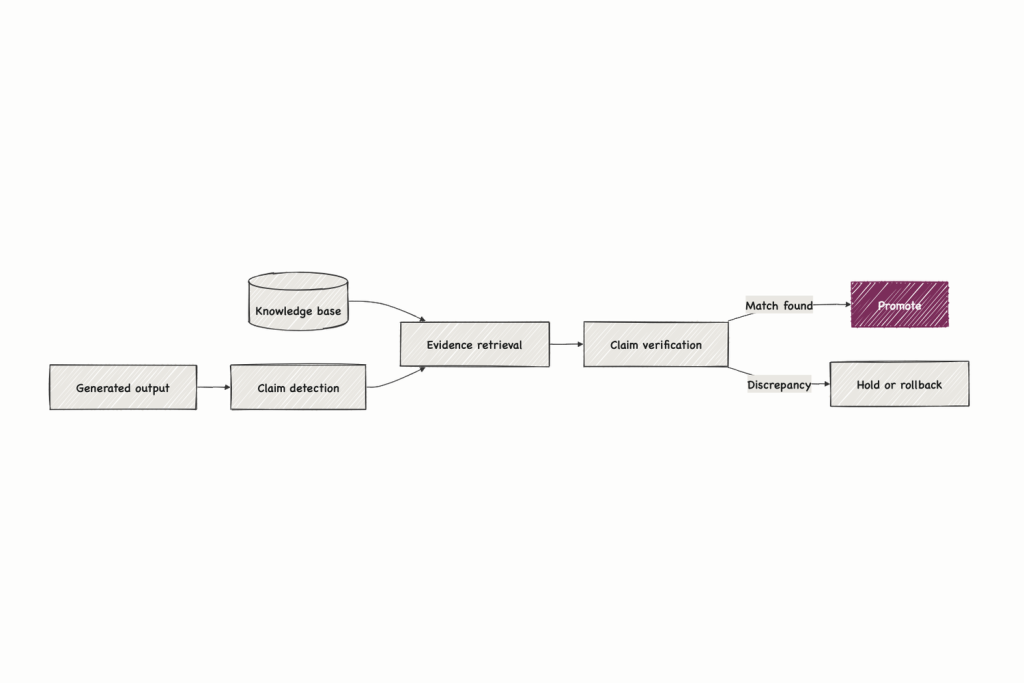
Start with structured steps. Automated fact-checking pipelines assist verifiers through a three-stage sequence consisting of claim detection, evidence retrieval, and claim verification (Source: MIT Press). To scale this process, advanced frameworks like VERIFAID use FAISS-based systems and multi-agent LLM architectures to automate validation and cross-validate claims against authoritative sources (Source: Oxford University Press). This keeps hallucinations low.
Deploy gates carefully. To ensure search intent is met, production LLM evaluation measures application-specific performance across key dimensions including correctness, faithfulness, and relevance (Source: Galtea Blog). An automated self-testing framework for LLMs introduces quality gates with evidence-based release decisions categorized as PROMOTE, HOLD, or ROLLBACK (Source: arXiv).
What does this mean for a site operator using API integration? * High-performing content gets promoted immediately. * Flawed articles are held for review. * Failed assets trigger a rollback.
This secures your risk profile. While building citation metrics and information gain, moving toward structured schema ensures your site survives core updates and helpful content reviews. Operationalizing these technical gates protects your publishing business from systemic search penalties.
Programmatic E-E-A-T and Author Accountability Signals
How does Google penalize AI content? It targets unverified scale. To survive, your site operator must immediately anchor automated drafts to recognized real-world entities. This shifts the focus from individual articles to author accountability. According to the Murat Ulusoy Blog, the author entity, rather than the individual article, is a primary lever for Google’s E-E-A-T evaluation framework. Search Quality Rater Guidelines use human raters to evaluate content based on Experience, Expertise, Authoritativeness, and Trustworthiness (Source: Google Search Central). High-performing publishing networks manage content decay by verifying that real experts shape every piece of generative text. Risk profiles drop.
- Embed real-world experts. They address search intent and ensure information gain.
- Structured schema must represent who actually created the content.
- Cite authoritative sources to raise citation metrics.
Act now. Organizations must embed real experts, structure everything with schema, and optimize for entities (Source: CXL). To align E-E-A-T with programmatic SEO, use specific schema markup. Author schema properties, such as Person vs. Author, inform search engines about who created the content, adhering to Google’s author markup best practices (Source: Google Search Central). However, any marked-up content must be visible on the page to avoid manual spam actions (Source: L7 Creative). This prevents scaled content abuse. It leads to our next pillar.
Comparing AI Tooling Approaches: SEO-First vs. Engineering-Grade
How does Google penalize AI content? The answer lies in the massive gap between basic keyword tools and engineering-grade engines. Basic tools produce flat text that accelerates content decay and triggers scaled content abuse reviews. In contrast, engineering-grade AI is defined by what happens after the answer is returned: the source is visible, the reasoning is traceable, and the output is verifiable (Source: Accuris Tech Blog).
Comparing these approaches reveals critical structural differences: * Factual Grounding: Cheap tools guess facts. Engineering engines use Retrieval-Augmented Generation (RAG) to connect to a verified knowledge base, though RAG introduces retrieval noise and relevance mismatches (Source: arXiv:2603.19281v1). * Risk Management: For enterprise applications answering thousands of queries daily, even a 2% to 3% retrieval error rate in RAG systems poses a structural risk (Source: N-iX RAG Evaluation Guide (2026)).
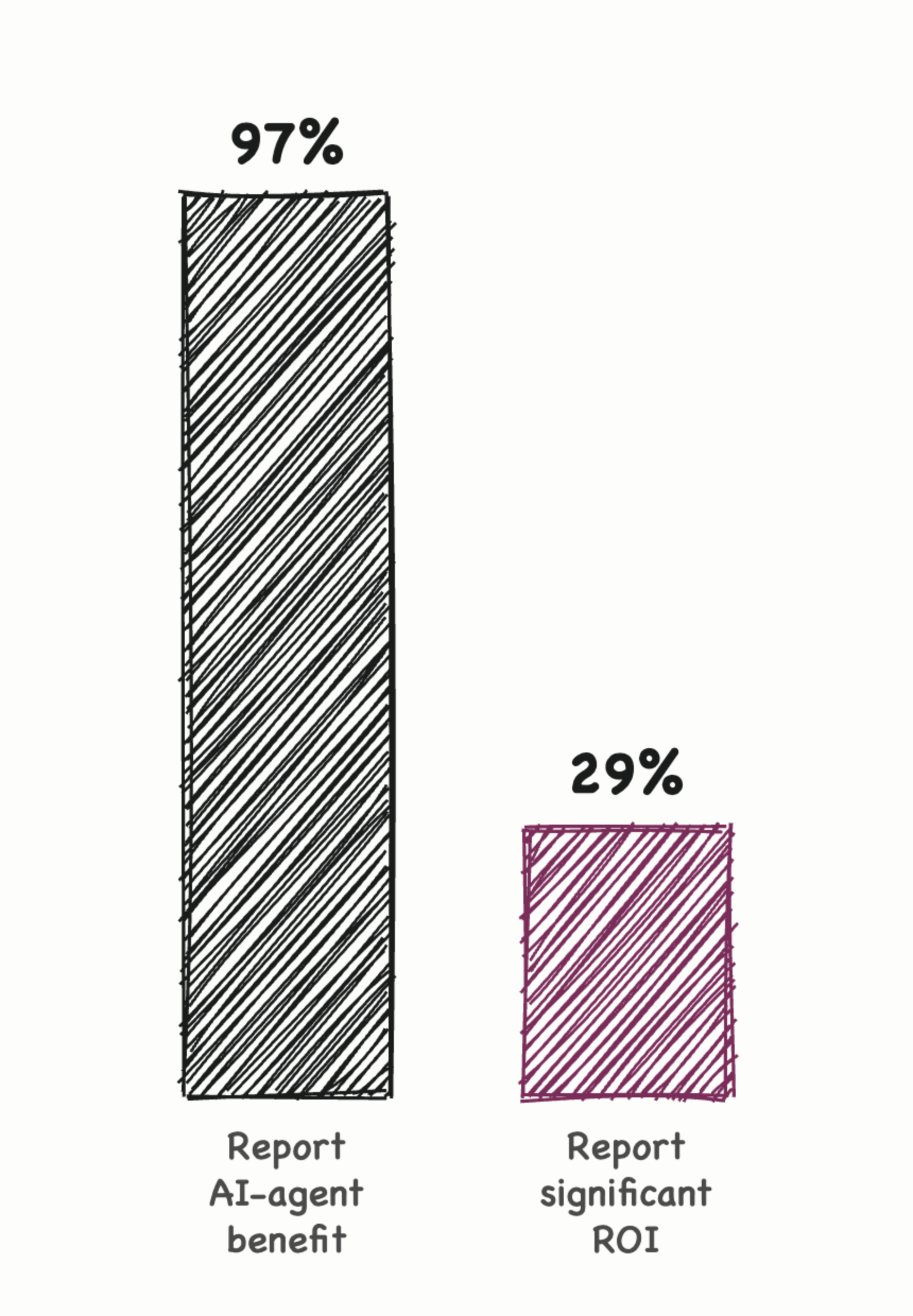
While 97% of executives report benefits from deploying AI agents, only 29% report significant ROI from generative AI (Source: Writer.com Enterprise AI Adoption Report (2026)). Enterprise adoption of agentic AI is growing, but 62% of adopting enterprises remain in the experimentation phase, with only 13% reaching full deployment (Source: First Page Sage Agentic AI Adoption Statistics). Moving beyond basic tools reduces your risk profile. This technical shift changes how systems manage the entire content lifecycle.
The Strategic Framework: Decision Trees & Content Decay
Building on these engineering-grade tools, modern publishers face a silent threat. Does google penalize ai content? It does when systems ignore how information ages. Traditional content decay involves a slow, gradual decline in organic traffic and search rankings over months or years, according to Ahrefs. However, AI content decay operates differently. WordStream reports that AI content decay occurs when content remains visible but is no longer interpreted or surfaced the same way by search engines, or when information becomes outdated and loses credibility. This is a quiet disaster. For platforms optimized for AI Overviews and answer engines, Marcel Digital notes that content decay can cause immediate, difficult-to-track traffic drops.
How can publishers address this threat? Strategists need a structured framework. Search Engine Land suggests that a content decision tree provides a structured framework to guide content strategists through evaluating and addressing content decay. Use this process to manage your content lifecycle:
- Track visibility drops to identify scaled content abuse or decaying pages.
- Evaluate information gain against your active knowledge base.
- Prune outdated materials to lower your site’s risk profile.
Automated content refresh tools leverage AI to continuously update and optimize pages, scaling SEO and Generative Engine Optimization (GEO) visibility, according to Social Spike. This automated site operator model secures long-term performance.
Conclusion: A 2025-Ready Blueprint for US Content Leads
Does Google penalize AI content? No. According to Google Search Central Documentation, automated ranking systems prioritize helpful, reliable information created primarily for people rather than to manipulate search rankings. Scaled content abuse occurs only when publishers bypass quality gates and flood indexes with thin, automated spam.
Publishers must adapt to survive. Generative Engine Optimization (GEO) is now the standard practice of structuring and optimizing content so that AI-powered search engines can find, understand, and cite it (Source: LLMRefs).
Your 2025-ready checklist: * Lead with direct answers to lower your hallucination rate. * Use clear headings mapping to likely prompts to eliminate conversational filler (Source: Advertising Week). * Structure entity definitions and source networks to make LLMs cite your brand (Source: Gen Optima). * Implement automated content pruning to stop content decay.
This systematic approach to citation metrics secures your search footprint. Contact AWRSHIFT to deploy an AI site operator and protect your content lifecycle today.
Frequently Asked Questions
Does Google penalize AI-generated content if it is left unedited?
No, Google does not penalize AI content based on its origin, but its algorithms actively filter out low-quality or unhelpful text, according to a Rankability SEO study. Leaving unedited AI content online risks triggering Google’s helpful content system if the material fails to add value. Google Search Central notes that automation is acceptable as long as it is not used to manipulate rankings.
What is the difference between SEO-first AI writers and engineering-grade engines?
SEO-first tools like Surfer SEO AI typically focus on keyword density and basic structures to rank quickly. Conversely, engineering grade AI article engines use deep datasets and advanced logic to generate authoritative drafts. These advanced setups integrate a rigorous fact-checking AI layer to verify claims, preventing the structural hallucinations common in simpler tools.
How do search engines identify scaled content abuse?
Google targets scaled content abuse by identifying high volumes of pages generated without adding user value, as outlined in Google Search Essentials. During the March 2024 core update, Google combined algorithm updates with new spam policies to trigger manual actions. Violating sites faced mass de-indexing, with some losing up to 90% of organic traffic in a single day, according to a Breakline Agency report.
Should content leads use AI detectors to verify the quality of their articles?
Content leads should not rely solely on AI detectors for quality control, as research cited by Quora shows their accuracy rates average only 39.5% to 60%. While some teams use tools for humanizing AI content to bypass these systems, detectors are easily fooled. Instead, modern workflows verify origin by combining detection algorithms with plagiarism checks and citation analysis.
What is the most effective way to prevent rapid content decay on an AI-heavy site?
Preventing rapid content decay requires a proactive strategy that treats content as an ongoing lifecycle rather than a static asset. Implementing automated refreshing ensures that statistics, links, and insights remain accurate over time. This continuous maintenance prevents search engines from categorizing aging machine-generated pages as thin or outdated content.
Written by AWRSHIFT Team