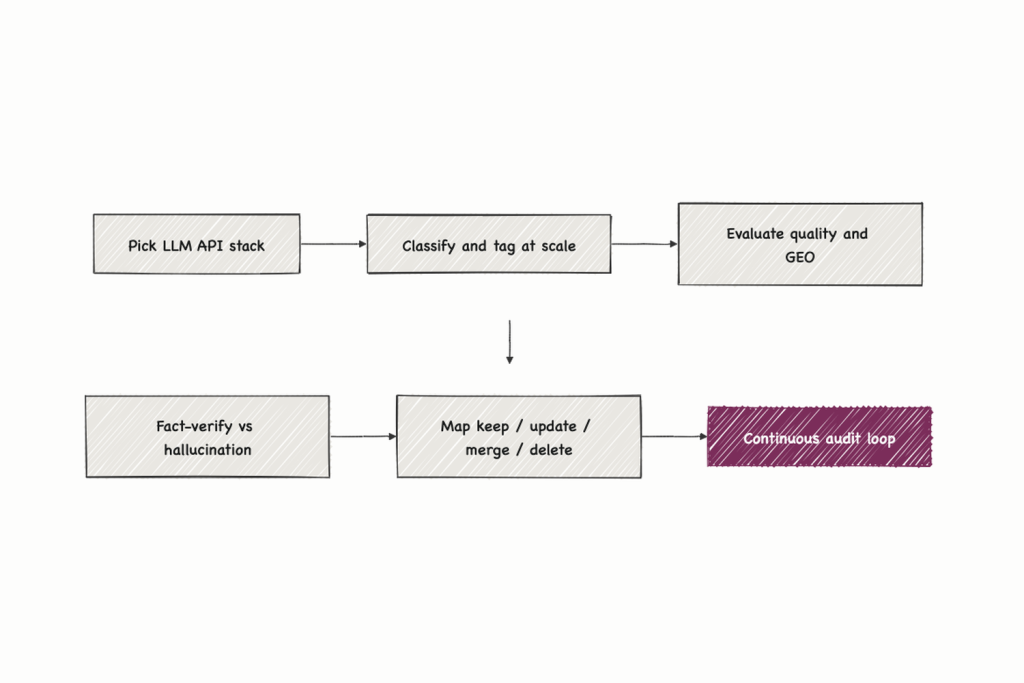
Introduction: Why Manual Audits Are Obsolete in the Era of LLMs
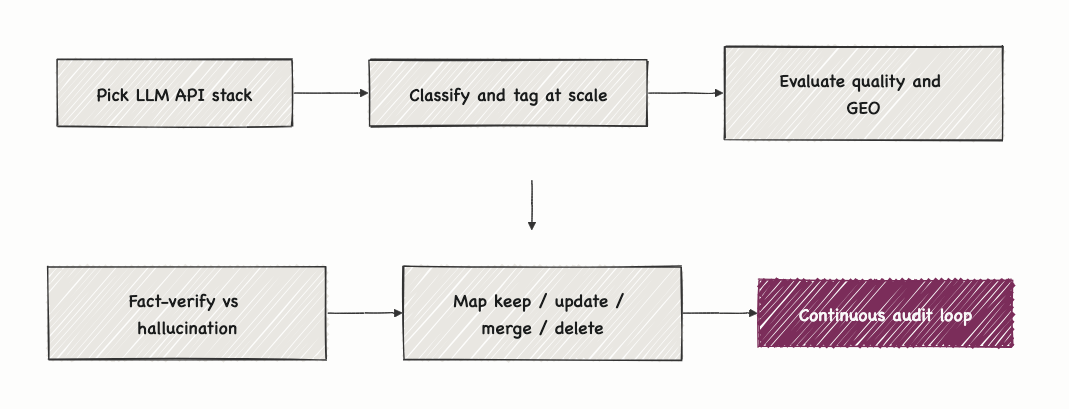
Manual spreadsheets are dead. While a basic content inventory merely lists your existing assets, a true content audit evaluates actual performance, quality, and relevance to determine necessary strategic actions (Hannon Hill). Doing this work by hand in the era of generative engine growth is a recipe for failure. Consider the sheer scale of modern web pollution; Google’s evolving Helpful Content System aggressively penalizes sites that let outdated, low-value information linger. Programmatic audit workflows now use flexible APIs and pre-built connectors to enable smooth, automated data exchange across complex systems (Vero AI). This shift to automated evidence collection, matching, and cross-checking reduces manual preparation time by up to 80% (Orbiq). By deploying Large Language Models (LLMs) to scan your index, you instantly slash initial audit review times by up to 30% (PwC).
Why does this programmatic shift matter so much today?
- Eliminate Content Debt: Rapidly identify cannibalized clusters, redundant pages, and outdated assets rotting in search positions (iStudios Media).
- Defeat Content Decay: Catch falling traffic patterns before search engines flag your entire domain as unhelpful.
- Map Redirects Accurately: Prevent manual errors by using vector embeddings and semantic similarity to match old URLs to new targets.
- Control Token Limits: Run automated HTML parsing and text extraction through structured outputs without blowing your API costs.
The traditional manual content audit for seo cannot survive when competitors use an AI site operator to analyze search patterns in real time. Scraping crawler exports and running cosine similarity checks on your site architecture reveals instant content cannibalization issues that human eyes miss. Transitioning to these programmatic methods allows marketing teams to maintain perfect factual accuracy while automatically refreshing their digital footprint. Let us explore how modern infrastructure makes this transition possible.
Choosing the Stack: Cost-Effective LLM APIs for Large-Scale SEO Auditing
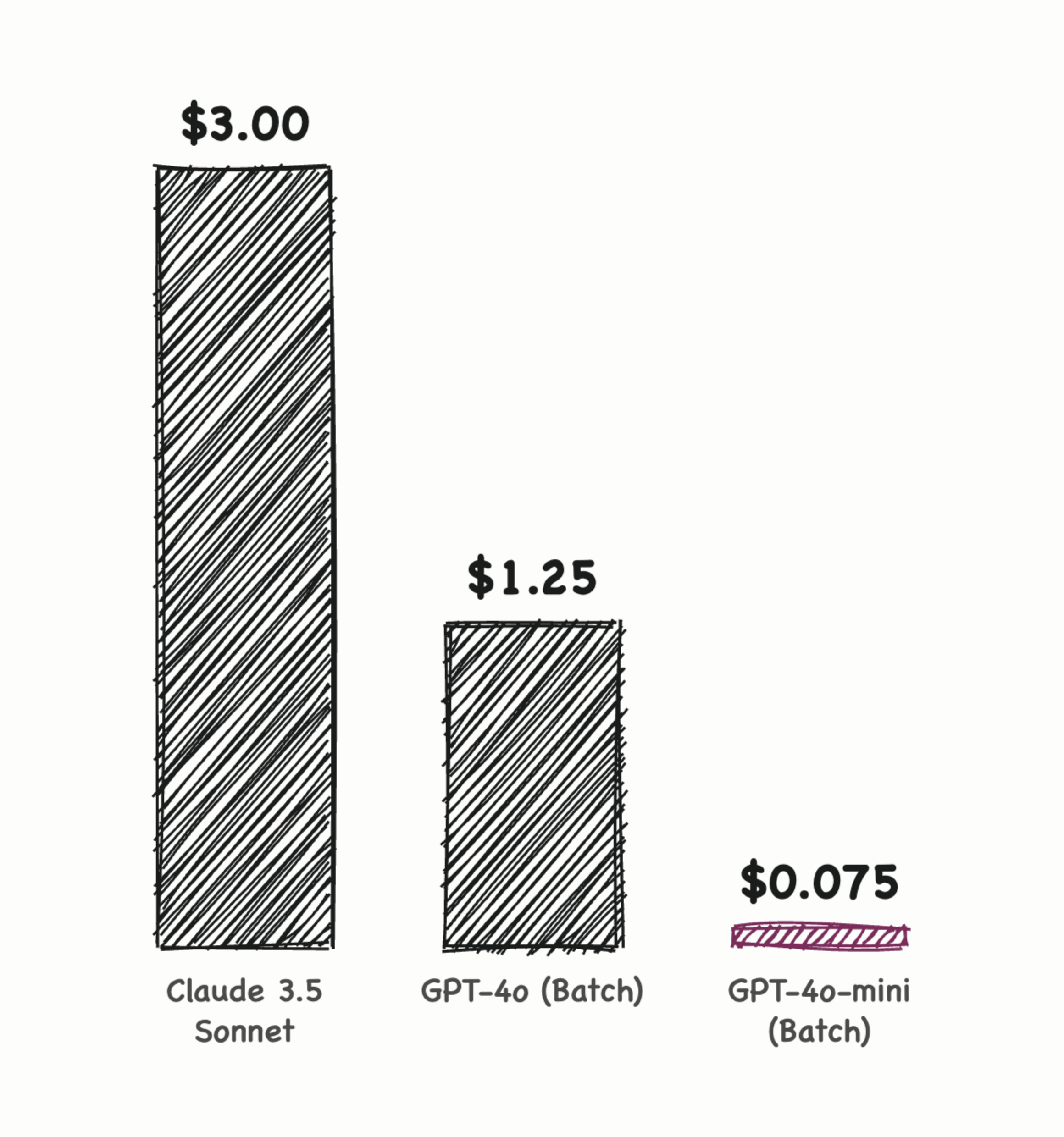
Building on this programmatic shift, choosing the right models dictates your entire content audit for seo budget. Claude 3.5 Sonnet has a massive 200K token context window for superior, fast analysis of long articles, costing $3.00 per million input tokens and $15.00 per million output tokens (Anthropic). Can you run a complete audit cheaper? Absolutely. Industry API pricing spans from free options up to $150.00 per million input tokens, but budget models start at just $0.07 per million input tokens (CostGoat).
- Claude 3.5 Sonnet: Best for deep semantic similarity checks on complex, structured outputs.
- GPT-4o: Standard pricing is $2.50 per million input tokens and $10.00 per million output tokens (AI Free API).
- GPT-4o-mini: The cheapest option for rapid HTML parsing and basic crawler exports.
How do you architect this cost-effectively when processing thousands of pages? Use asynchronous batch processing. OpenAI’s Batch API slashes standard rates by 50%, reducing GPT-4o to $1.25 per million input tokens and GPT-4o-mini to a mere $0.075 per million input tokens (OpenAI Community; AI Free API). Anthropic also lowers barriers by offering promotional pricing of $2.00 per million input tokens and $10.00 per million output tokens for Claude through August 31, 2026 (Claude Platform Docs). This architectural choice dramatically cuts api costs while bypassing traditional rate limits. This strategic setup prepares your pipeline for deep, scalable execution.
Programmatic Classification: Automated Intent, Type, and Persona Tagging
This programmatic setup prepares your pipeline for deep execution. Manual categorization fails when you manage thousands of pages. Relying on an AI-first content classification system instead automates tagging across enterprise systems to replace slow, error-prone spreadsheets (Kontent.ai). Automated document classification techniques now group news and web assets by identifying latent semantic patterns (ResearchGate). How does this help your content audit for seo?
| Metric | Rule-Based | Programmatic LLM |
|---|---|---|
| Categorization Speed | Hours | Seconds |
| Accuracy Standard | Under 40% | Over 60% (Metaflow) |
Smart pipelines use system prompts and strict json schema definitions to enforce structured outputs.
Designing these workflows requires strict quality parameters. Under modern programmatic SEO standards, every categorized page must feature at least 60% unique content, pull from three or more distinct sources, and offer genuine value beyond basic results (Metaflow). You must map these standards to the IAB Tech Lab Content Taxonomy to provide a standardized common language that defines the exact “aboutness” of your digital assets during automated classification (IAB Tech Lab). This architecture prevents search engines from flagging your active, database-driven templates as scaled spam (Entlify).
{
  "type": "object",
  "properties": {
    "intent": { "type": "string" },
    "persona": { "type": "string" }
  }
}
By passing raw crawler exports through structured models, your AI site operator determines intent and semantic similarity while containing api costs. This step ensures that your index remains clean, helpful, and highly targeted. Achieving this automated classification scale enables you to optimize the technical foundation of your entire digital footprint.
Evaluating Quality at Scale: Information Gain, GEO Visibility, and Decay Audits
Building on this automated classification scale, your content audit for seo must tackle how modern search engines evaluate quality. Google’s helpful content system is a core algorithmic component designed to reward people-first content and demote low-quality, search-engine-first content (Google Search Central Blog). LLMs identify this quality by analyzing information gain and identifying content decay across your site. Let’s compare traditional and modern evaluation methods.
| Evaluation Metric | Traditional SEO Audit | Modern GEO Audit |
|---|---|---|
| Primary Goal | Rank in list of links | Cited in AI answers |
| Audit Focus | Keyword density | Information gain |
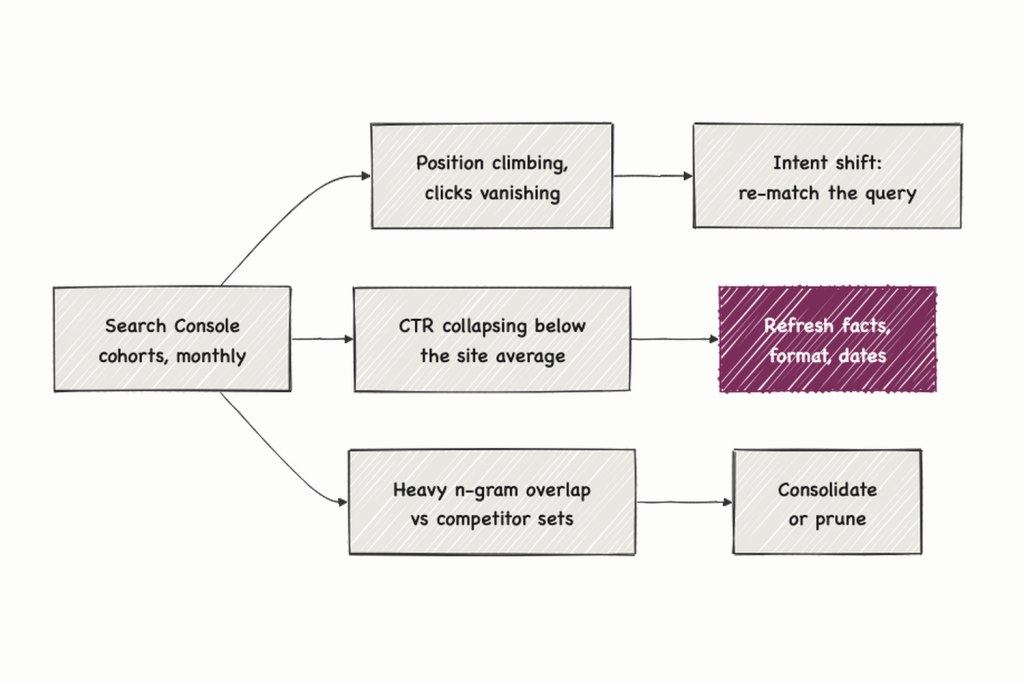
| Key Risk | Content cannibalization | Content decay |
- Vector Embeddings: Your AI site operator calculates semantic similarity across crawler exports using vector embeddings to find content cannibalization.
- Structured Outputs: System prompts verify factual accuracy by outputting results against a strict json schema to limit token limits.
- HTML Parsing: Fast text extraction checks for information gain by comparing incoming pages against known web databases.
How does generative engine optimization change your ranking strategy? Generative Engine Optimization (GEO) focuses on optimizing content to be cited and synthesized into AI-generated answers, whereas traditional SEO focuses on ranking in a list of links (Evertune). AI search grew to approximately 4.5% of organic traffic by September 2025, representing a 127% growth rate in just three months, with Gartner predicting 25% of traditional search queries will move to AI search by 2026 (Digital Agency Network). Also, the U.S. Generative Engine Optimization (GEO) Market is projected to reach USD 365.4 million in 2026, growing at a compound annual growth rate (CAGR) of 42.9% (Omnibound). This shift is massive. LLM optimization is evolving from intuition to measurement, requiring structured tracking of visibility and alignment with traditional SEO (Search Engine Land). Fortunately, GEO cannot work effectively without a strong SEO strategy because AI bots still check traditional factors like brand authority and reputable industry links (Reddit r/content_marketing). Programmatically monitoring these factors ensures your redirect mapping remains flawless while keeping api costs low. Managing these systems efficiently requires a deeper look into execution.
Automated Fact-Verification: Protecting Your Site Against AI Hallucinations
Building on this automated quality evaluation, your content audit for seo must address the critical issue of factual accuracy. Large language models often hallucinate, with hallucination rates spiking to 16% to 33% or more on typical benchmarks (Seekr). Can you trust your AI-generated pages to meet strict E-E-A-T guidelines? An AI hallucination detection tool is specialized software designed to quantify fabricated information by measuring factual consistency in model outputs (Galileo). Our site operator pipelines run automated, programmatic checks to identify these errors.
{
  "type": "object",
  "properties": {
    "groundedness_score": { "type": "number" },
    "hallucination_detected": { "type": "boolean" }
  }
}
This verification process relies on programmatic architecture to compare page claims.
- Knowledge Graphs: Integrating knowledge graphs with LLMs grounds the models in facts to boost data accuracy, improve governance, and reduce hallucinations (arXiv:2311.07914v2).
- Targeted Evaluation: The GraphEval framework identifies specific triples within a knowledge graph prone to hallucinations to pinpoint exactly where an LLM response is inaccurate (Amazon Science).
- Stand-Alone Verification: Certain hallucination detection methods achieve a competitive accuracy of approximately 66% without relying on external fact-checking sources (EdinburghNLP).
Engineers evaluate these bulk workflows using core metrics like groundedness, faithfulness, factuality, and consistency (Braintrust). Managing these checks prevents content decay. Deploying these defenses keeps your search visibility secure.
The Action Plan Framework: Programmatically Mapping Keep, Update, Delete, and Merge
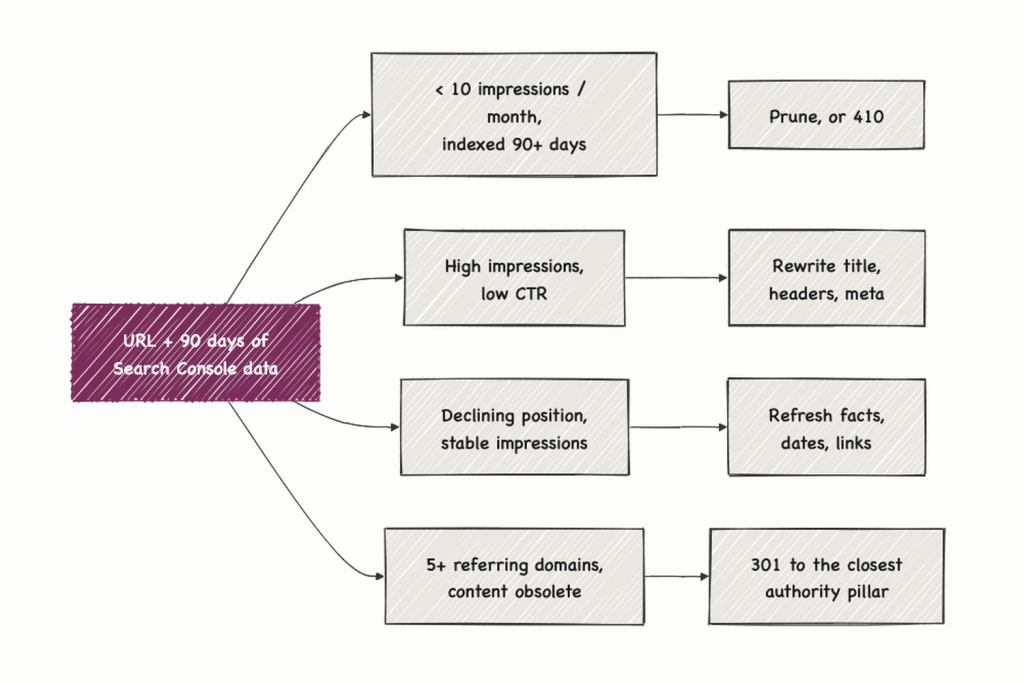
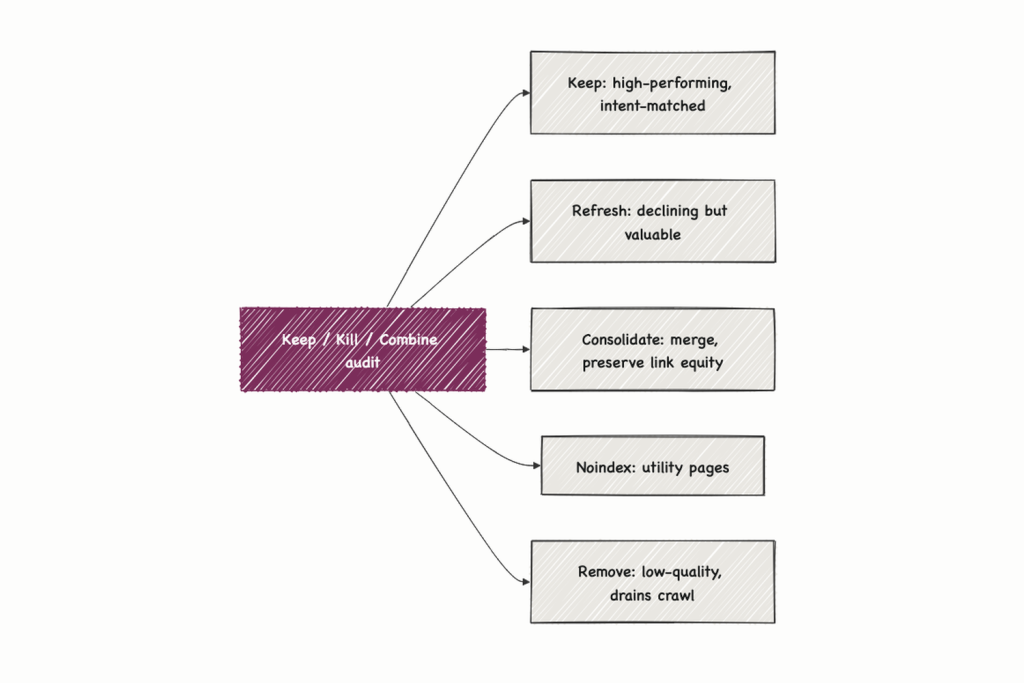
Building on these rigorous automated checks, execution requires a structured framework to process raw evaluations. How do we turn model analysis into rankings? A modern content audit for seo combines LLM-readiness checks across 70 programmatic criteria (including coverage, structure, and entities) with real-time traffic data (Emilia Moller via LinkedIn). Semrush defines this framework using clear actions: keep, update, consolidate, or prune (Semrush). We map crawler exports to actionable paths.
| Audit Action | Core Traffic Rule | LLM Evaluation Factor |
|---|---|---|
| Keep as is | Exceeds organic targets | High information gain |
| Update | Declining traffic | Low citation probability |
| Merge / Redirect | High semantic similarity | Redundant entities |
| Prune / Delete | Zero traffic | Low technical parseability |
- Spell: This programmatic framework synthesizes complex code edits natively through LLMs (arXiv:2602.01107v1).
- Automatic Maps: Systems programmatically generate clean redirect mapping alongside complex ontology relationships (Medium – Tasos Pardalis).
- Pruning: Removing digital clutter directly boosts search engine rankings and improves user experience (Contentful).
Traditional SEO checks only look at historical traffic. However, your site operator must determine whether search assistants will cite your content, which is a key metric in modern LLM-driven audits (EWR Digital). This automated mapping ensures your pages remain highly visible. We can now transition to the actual deployment of these automated strategies.
Shifting to the Site Operator Loop: Building a Continuous Audit Lifecycle
Building on this structured automated mapping, real-time content lifecycle management replaces static spreadsheets. Why use outdated snapshots when agentic AI allows active, continuous assurance (Trullion)? Smart systems construct an ongoing “site operator” loop. Landbase Blog reports that 79% of organizations used some level of agentic AI by 2025, and 96% planned to expand operations.
Modern platforms use traditional scraping infrastructure, including HTTP libraries or headless browsers, to access web pages directly (Medium – Anirudha Kuchibhotla). These background loops run continuously to monitor semantic similarity and guard against content decay.
How does your team trigger these checks? Micro-audits run programmatically whenever teams publish pages.
- Instant Session Fixes: Automated systems find stale pages, missing metadata, and terminology drift, letting users fix issues immediately via an AI Content Agent (Sanity.io).
- Scheduled Validation: The site operator loop handles crawler exports, metadata validation, expired content, and structured outputs (Optimizely).
- Agentic Frameworks: Modern pipelines deploy tools like LangChain, CrewAI, Microsoft Agent Framework, or LlamaIndex Workflows to run checks (LangChain Resources).
This continuous cycle ensures your material remains fresh. Continuous monitoring protects your search performance.
Conclusion: Scalable SEO Mastery with Programmatic Auditing
Continuous loops replace dead spreadsheets. When content cannibalization quietly destroys your traffic, manual analysis of vector embeddings and cosine similarity fails completely, making automated systems the only logical path forward for modern enterprise websites. Technical teams save hundreds of hours by feeding crawler exports directly into structured outputs with strict json schema controls. This real-time validation stops decay. It prevents indexing issues. For what this looks like at full-site scale (884 pages read end to end, every finding refutation-tested before a human saw it), see the case study.
Will your brand adapt? Legacy platforms cannot handle modern token limits or the complex html parsing required for deep text extraction. To survive, smart SEO leads must deploy a permanent AI site operator to manage redirect mapping, maintain factual accuracy, and maximize information gain across their entire digital footprint. Run your first automated audit today.
Frequently Asked Questions
What is the difference between a content inventory and a content audit for SEO?
A content inventory simply lists existing assets. In contrast, a content audit for seo evaluates performance, quality, and relevance to determine necessary strategic actions for your pages, as noted by Hannon Hill.
How can I evaluate a site for AI hallucinations and fact-verify claims automatically during an audit?
To run a programmatic hallucination audit, use modern workflows with flexible APIs and AI-first classification systems. This approach automates fact-verification by cross-checking assets against trusted sources. According to Orbiq, automating routine testing reduces manual collection and preparation time by up to 80%.
How do you run a programmatic content audit for SEO across 1,000+ pages for under $50?
You can achieve cost-effective auditing by using budget LLM APIs. For example, OpenAI’s Batch API offers a 50% discount, pricing GPT-4o-mini at just $0.075 per million input tokens. This makes running a large-scale content audit for seo highly affordable.
What actionable frameworks should I use to decide whether to keep, update, delete, or merge a page?
Use a structured content audit for seo to identify critical ‘Content Debt’ like outdated, low-value, or underperforming content. This framework helps you decide whether to keep update delete merge. According to iStudios Media, this process quickly uncovers cannibalized clusters and pages sitting in search positions 4 to 20.
How do we shift our SEO operations from static annual spreadsheets to a continuous audit loop?
Transitioning to a continuous content lifecycle relies on an automated site operator. By utilizing pre-built connectors and LLM APIs, you can automate data exchange and classification. According to PwC, adopting these models reduces initial audit review times by up to 30%.
Written by AWRSHIFT Team