Beyond the Vague Content Audit: An Engineering Approach
According to Ahrefs data, around 96.5% of pages get zero organic traffic from Google. Most teams respond to this with a superficial content audit that catalogs URLs in a spreadsheet and stops there. That inventory has no decision power. It treats every page as an isolated row instead of a node in a linked system, so nothing in it tells you whether a declining URL deserves a refresh, a rewrite, or a 301. Effective SEO triage needs a framework where historical performance data meets query coverage analysis, because intuition does not scale to a site with five thousand pages competing for the same narrow intent match.
A useful audit moves past word counts into a decision matrix built on three variables:
- Traffic integrity: soft 404 errors and status code volatility that disrupt the crawl cycle.
- Topical density: entity extraction to measure semantic consistency against high-authority competitors.
- Structural value: referring domains and internal links, which together determine which assets deserve protection.
Rankings decline when impression volume drops while your crawl budget stays static. A cannibalization audit shows exactly where overlapping pages dilute topic authority. The working rule: treat content as a liability until it proves its value through conversion data or Search Console visibility. Everything below is a repeatable triage workflow built on that rule.
The Quantitative Matrix: Thresholds for Content Action
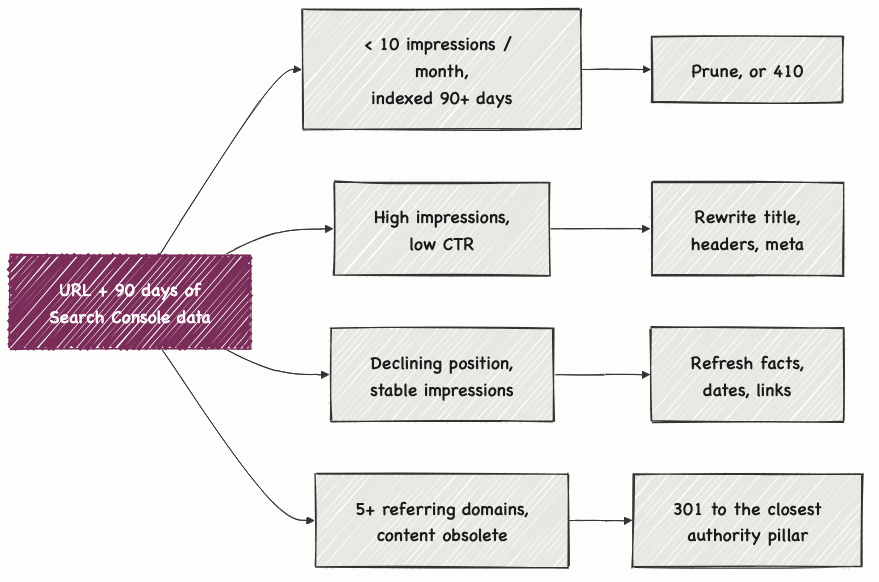
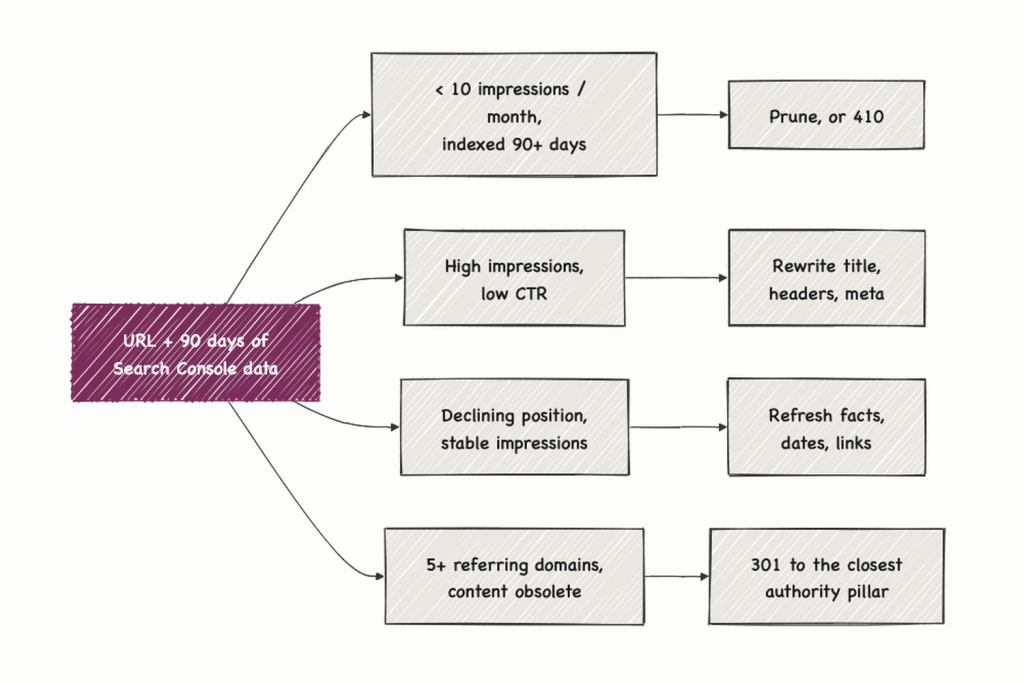
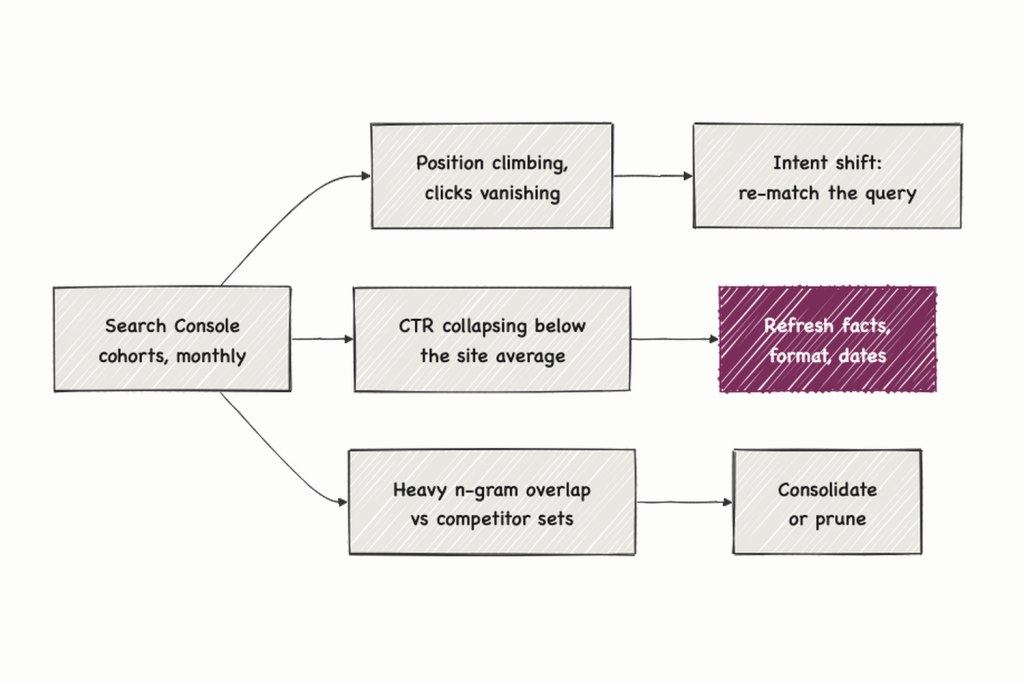
Impression volume is your leading indicator of latent potential. Google Search Console now provides a dedicated generative-AI performance report that counts an impression only when your URL is actually rendered and visible inside AI Overviews or AI Mode, including after a collapsed section expands (Source: Google Search Central). Low click-through on high impressions usually means the page already matches intent but loses the click on weak titles and metadata. A URL that holds zero impressions over roughly ninety days after being confirmed indexable and properly canonicalized signals weak query alignment, internal competition, or low search demand. It is a strong prune candidate, though not proof of failure on its own. And pages with high impression volume but declining position are the classic content decay profile: those want a refresh, not a redirect.
| Metric threshold | Primary signal | Recommended content action |
|---|---|---|
| < 10 monthly impressions, 90+ days indexed | Dead asset | Prune, or 410 if no links point at it |
| High impressions / low CTR | Mismatched packaging | Rewrite title, headers, meta description |
| Declining position, stable impressions | Content decay | Refresh facts, dates, and internal links |
| > 5 referring domains, obsolete content | Link equity value | 301 to the closest authority pillar |
Link equity is the reason redirect decisions outrank rewrite decisions in this matrix. A 301 from a page with real referring domains into a newer, closely related asset preserves most of the transferred value (Source: Search Engine Land). The redirect target has to be topically close: sending everything to the homepage strips the specific intent match and often ends as a soft 404 in Google’s eyes. These thresholds map directly onto your site architecture, which makes overlapping clusters identifiable by query rather than by gut feel.
The Order of Operations: Avoiding Canonical Chaos
Sequence matters more than most audits admit. Digital decay is real and measurable: Pew Research Center found that 38% of pages from 2013, and even 8% of pages from 2023, were already unavailable by mid-2024. But merging URLs without first auditing your internal links creates chains of hops that waste crawl budget and frustrate users. Your triage workflow fails if a high-authority pillar points at a page you just deleted. So fix every internal link aimed at a target URL before you initiate the 301 redirect or 410 removal, not after.
Within the decision matrix, the redirect methods themselves are not interchangeable:
| Redirect type | Speed of discovery | Impact on link equity | Best use case |
|---|---|---|---|
| Server-side 301 | Immediate | Transfers ~95-99% | Permanent page merges |
| Meta refresh | Variable | Depends on delay timer | Temporary UI transitions |
| Rel=canonical | Moderate | Consolidates signals | Managing near-duplicates |
Google Search does recognize delayed meta refresh redirects, but treatment depends on the interval the site owner sets (Source: Google Search Central). Server-side 301s stay the default for structural changes. After a wave of merges, wait out a full crawl cycle before judging results: index stability lags your edits, and rushing a second wave of consolidation before the index settles produces volatile rankings you cannot attribute to anything. That waiting discipline is unglamorous, and it is also the difference between a measured migration and a maze.
The Query Coverage Defense: Why Zero-Click Pages Matter
Here is the paradox that breaks naive pruning: some of your least-clicked pages are working. Zero-click behavior dominates AI surfaces. Seer Interactive’s measured CTR data and Semrush’s AI Mode research both point the same direction: when an AI interface answers in place, the overwhelming majority of those sessions end without a click to any external site. A page can earn impressions inside AI Overviews, feed your topical coverage, and still look dead in a click-sorted spreadsheet.
| Signal type | AI impact | Long-term value |
|---|---|---|
| Entity density | High | Improves brand association in LLM answers |
| Query coverage | Medium | Captures broad intent match |
| Link equity | High | Powers index stability across silos |
So before the delete column fills up, check query coverage. A URL that appears for a wide set of queries, or surfaces in AI Overviews, is doing defensive work for the whole cluster even at near-zero CTR. Deleting it narrows the set of questions your site is eligible to answer. Redirecting it to the homepage is worse: the niche depth that earned those impressions does not survive the hop. Keep such pages, refresh their weakest sections, and let them hold territory. The click was never the only unit of value; in AI-mediated search it is not even the main one.
Triage at Scale: A Worked Protocol
Honesty first: this site is five articles old, so we have no decayed backlog of our own to triage yet. What we do have is the audit machinery this matrix plugs into, and the workflow below is the one we built it for. It is written for a realistic case, a legacy blog of a few hundred URLs, and it uses only the signals discussed above.
A content inventory documents what exists. A content audit decides what deserves to keep existing. The matrix is what turns the second step from opinion into procedure.
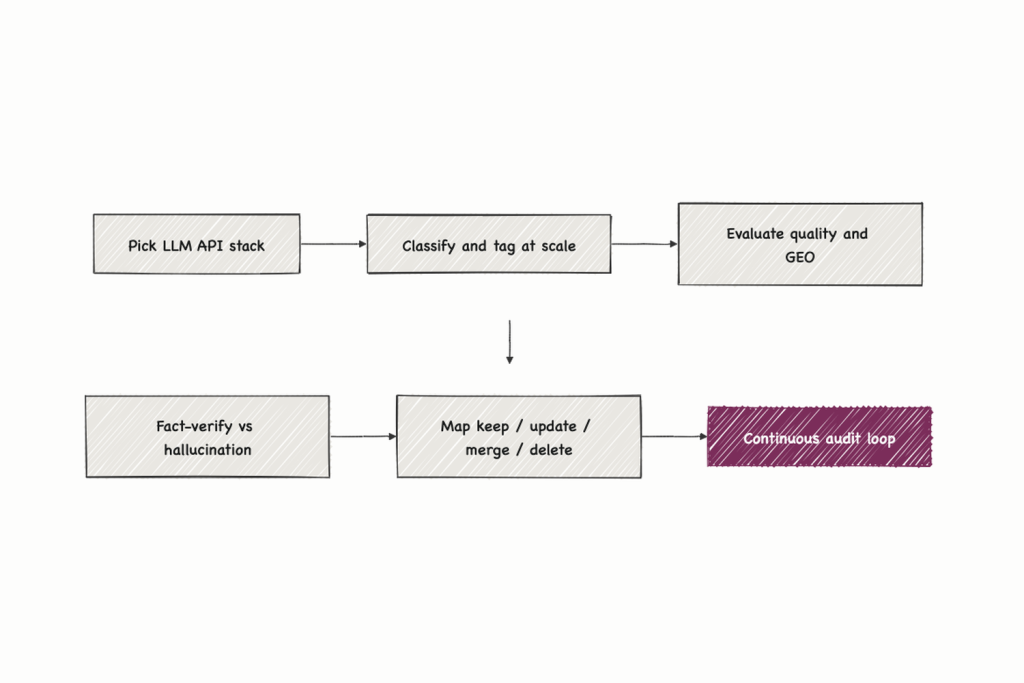
The protocol runs in four passes:
- Extract. Pull impressions, clicks, position, and indexing state from Search Console, plus referring domains and internal-link counts from your crawler into one master sheet. One row per URL, no exceptions.
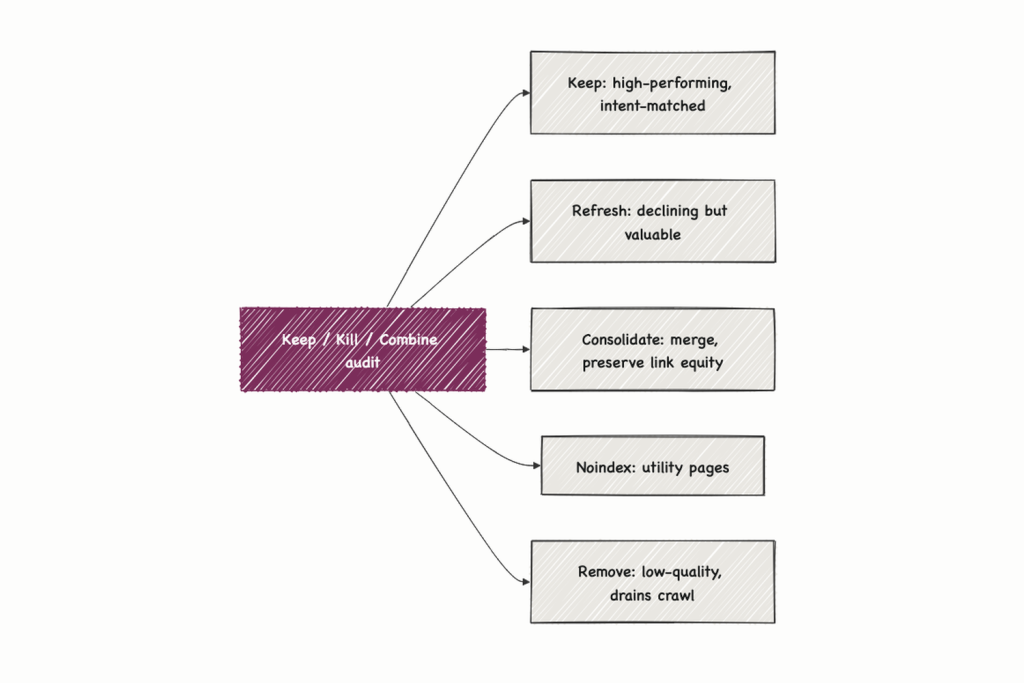
- Classify. Apply the matrix thresholds mechanically: Keep (consistent impressions, semantic consistency intact), Update (decay profile but strong referring domains), Merge (cannibalization within a cluster), Delete (thin content, no links, no impressions after 90+ indexed days).
- Sequence. Fix internal links first, then execute merges and deletions, then wait out a crawl cycle before touching the Keep and Update piles. Numerical triggers, such as a sustained multi-month collapse in impression volume, decide entry into the queue; publication date never does.
- Re-measure. Compare position and impression volume cluster by cluster, not sitewide, so consolidation wins are not masked by unrelated losses. Industry experience puts meaningful movement at three to six months, with early signals sometimes inside the first weeks.
The classification pass is the same scaled-audit approach we detailed in our AI content audit workflow, and the Delete pile follows the evidence rules from our content pruning guide: prune on measured signals, never on age. What this protocol removes from the process is the editorial meeting where someone argues a page “feels important”. The sheet either shows referring domains and impressions, or it does not.
Precision as the Future of Content Maintenance
A decision matrix turns content maintenance from a guessing game into an engineering workflow. Age-based cleanups keep deleting pages that search engines still consider authoritative, which is why logic-driven triage beats publication-date triage (Source: Search Engine Journal). The maintenance loop that follows from everything above is short: watch impression volume and link equity per URL, act only on thresholds, sequence redirects behind internal-link fixes, and give the index time to settle between waves. None of it requires new tooling. All of it requires the discipline to let the numbers overrule the publishing calendar.
Frequently Asked Questions
What is the primary difference between a content inventory and a content audit?
A content inventory is a quantitative catalog of every asset on a domain: URL, type, word count, status code. A content audit is the evaluation layer on top, judging each asset against performance thresholds to decide whether it gets refreshed, rewritten, merged, or removed. The inventory identifies what you have; the audit dictates what happens to it.
How do you identify underperforming or thin content using measurable signals?
Look for the combination of low organic impressions over a sustained indexed period, few or no referring domains, and shallow topical coverage relative to the pages it competes with. Any one signal alone is noisy; a URL failing all three at once is a reliable prune or merge candidate.
Why is it necessary to wait for a crawl cycle between audit waves?
Search engines need time to process redirects and removals before the index reflects your changes. If you launch a second wave of consolidation while the first is still settling, rankings turn volatile and you can no longer attribute movement to specific actions. Full effects of a large consolidation typically take three to six months to stabilize.
When should you choose a content rewrite over a simple refresh?
Refresh when the page’s core intent still matches search behavior and only facts, examples, or dates have aged. Rewrite when the intent itself has shifted, when the structure cannot support current ranking signals, or when decay has gone so deep that updating individual sections would leave a contradictory page. Pew Research Center’s finding that 38% of 2013-era pages were unavailable by mid-2024 shows how far past refresh-range old content can drift.
Why should high-impression pages with zero clicks be kept?
Because in AI-mediated search, the click is no longer the only unit of value. Measured studies from Seer Interactive and Semrush show that sessions answered inside AI interfaces overwhelmingly end without an external click, yet the cited pages still earn brand visibility and hold query coverage for their cluster. Deleting them narrows the question space your site can answer and weakens the topical authority of everything around them.
Written by AWRSHIFT Team