Category: Content Lifecycle

  • The Programmatic Content Audit for SEO: A 1,000-Page LLM Workflow

    Quality auditQuality 92/100SEO 80Human-style 100Sources 3511 min read

    Introduction: Why Manual Audits Are Obsolete in the Era of LLMs

    Manual spreadsheets are dead. While a basic content inventory merely lists your existing assets, a true content audit evaluates actual performance, quality, and relevance to determine necessary strategic actions (Hannon Hill). Doing this work by hand in the era of generative engine growth is a recipe for failure. Consider the sheer scale of modern web pollution; Google’s evolving Helpful Content System aggressively penalizes sites that let outdated, low-value information linger. Programmatic audit workflows now use flexible APIs and pre-built connectors to enable smooth, automated data exchange across complex systems (Vero AI). This shift to automated evidence collection, matching, and cross-checking reduces manual preparation time by up to 80% (Orbiq). By deploying Large Language Models (LLMs) to scan your index, you instantly slash initial audit review times by up to 30% (PwC).

    Why does this programmatic shift matter so much today?

    • Eliminate Content Debt: Rapidly identify cannibalized clusters, redundant pages, and outdated assets rotting in search positions (iStudios Media).
    • Defeat Content Decay: Catch falling traffic patterns before search engines flag your entire domain as unhelpful.
    • Map Redirects Accurately: Prevent manual errors by using vector embeddings and semantic similarity to match old URLs to new targets.
    • Control Token Limits: Run automated HTML parsing and text extraction through structured outputs without blowing your API costs.

    The traditional manual content audit for seo cannot survive when competitors use an AI site operator to analyze search patterns in real time. Scraping crawler exports and running cosine similarity checks on your site architecture reveals instant content cannibalization issues that human eyes miss. Transitioning to these programmatic methods allows marketing teams to maintain perfect factual accuracy while automatically refreshing their digital footprint. Let us explore how modern infrastructure makes this transition possible.

    Choosing the Stack: Cost-Effective LLM APIs for Large-Scale SEO Auditing

    Building on this programmatic shift, choosing the right models dictates your entire content audit for seo budget. Claude 3.5 Sonnet has a massive 200K token context window for superior, fast analysis of long articles, costing $3.00 per million input tokens and $15.00 per million output tokens (Anthropic). Can you run a complete audit cheaper? Absolutely. Industry API pricing spans from free options up to $150.00 per million input tokens, but budget models start at just $0.07 per million input tokens (CostGoat).

    • Claude 3.5 Sonnet: Best for deep semantic similarity checks on complex, structured outputs.
    • GPT-4o: Standard pricing is $2.50 per million input tokens and $10.00 per million output tokens (AI Free API).
    • GPT-4o-mini: The cheapest option for rapid HTML parsing and basic crawler exports.

    How do you architect this cost-effectively when processing thousands of pages? Use asynchronous batch processing. OpenAI’s Batch API slashes standard rates by 50%, reducing GPT-4o to $1.25 per million input tokens and GPT-4o-mini to a mere $0.075 per million input tokens (OpenAI Community; AI Free API). Anthropic also lowers barriers by offering promotional pricing of $2.00 per million input tokens and $10.00 per million output tokens for Claude through August 31, 2026 (Claude Platform Docs). This architectural choice dramatically cuts api costs while bypassing traditional rate limits. This strategic setup prepares your pipeline for deep, scalable execution.

    Programmatic Classification: Automated Intent, Type, and Persona Tagging

    This programmatic setup prepares your pipeline for deep execution. Manual categorization fails when you manage thousands of pages. Relying on an AI-first content classification system instead automates tagging across enterprise systems to replace slow, error-prone spreadsheets (Kontent.ai). Automated document classification techniques now group news and web assets by identifying latent semantic patterns (ResearchGate). How does this help your content audit for seo?

    Metric Rule-Based Programmatic LLM
    Categorization Speed Hours Seconds
    Accuracy Standard Under 40% Over 60% (Metaflow)

    Smart pipelines use system prompts and strict json schema definitions to enforce structured outputs.

    Designing these workflows requires strict quality parameters. Under modern programmatic SEO standards, every categorized page must feature at least 60% unique content, pull from three or more distinct sources, and offer genuine value beyond basic results (Metaflow). You must map these standards to the IAB Tech Lab Content Taxonomy to provide a standardized common language that defines the exact “aboutness” of your digital assets during automated classification (IAB Tech Lab). This architecture prevents search engines from flagging your active, database-driven templates as scaled spam (Entlify).

    {
      "type": "object",
      "properties": {
        "intent": { "type": "string" },
        "persona": { "type": "string" }
      }
    }

    By passing raw crawler exports through structured models, your AI site operator determines intent and semantic similarity while containing api costs. This step ensures that your index remains clean, helpful, and highly targeted. Achieving this automated classification scale enables you to optimize the technical foundation of your entire digital footprint.

    Evaluating Quality at Scale: Information Gain, GEO Visibility, and Decay Audits

    Building on this automated classification scale, your content audit for seo must tackle how modern search engines evaluate quality. Google’s helpful content system is a core algorithmic component designed to reward people-first content and demote low-quality, search-engine-first content (Google Search Central Blog). LLMs identify this quality by analyzing information gain and identifying content decay across your site. Let’s compare traditional and modern evaluation methods.

    Evaluation Metric Traditional SEO Audit Modern GEO Audit
    Primary Goal Rank in list of links Cited in AI answers
    Audit Focus Keyword density Information gain
    Key Risk Content cannibalization Content decay
    • Vector Embeddings: Your AI site operator calculates semantic similarity across crawler exports using vector embeddings to find content cannibalization.
    • Structured Outputs: System prompts verify factual accuracy by outputting results against a strict json schema to limit token limits.
    • HTML Parsing: Fast text extraction checks for information gain by comparing incoming pages against known web databases.

    How does generative engine optimization change your ranking strategy? Generative Engine Optimization (GEO) focuses on optimizing content to be cited and synthesized into AI-generated answers, whereas traditional SEO focuses on ranking in a list of links (Evertune). AI search grew to approximately 4.5% of organic traffic by September 2025, representing a 127% growth rate in just three months, with Gartner predicting 25% of traditional search queries will move to AI search by 2026 (Digital Agency Network). Also, the U.S. Generative Engine Optimization (GEO) Market is projected to reach USD 365.4 million in 2026, growing at a compound annual growth rate (CAGR) of 42.9% (Omnibound). This shift is massive. LLM optimization is evolving from intuition to measurement, requiring structured tracking of visibility and alignment with traditional SEO (Search Engine Land). Fortunately, GEO cannot work effectively without a strong SEO strategy because AI bots still check traditional factors like brand authority and reputable industry links (Reddit r/content_marketing). Programmatically monitoring these factors ensures your redirect mapping remains flawless while keeping api costs low. Managing these systems efficiently requires a deeper look into execution.

    Automated Fact-Verification: Protecting Your Site Against AI Hallucinations

    Building on this automated quality evaluation, your content audit for seo must address the critical issue of factual accuracy. Large language models often hallucinate, with hallucination rates spiking to 16% to 33% or more on typical benchmarks (Seekr). Can you trust your AI-generated pages to meet strict E-E-A-T guidelines? An AI hallucination detection tool is specialized software designed to quantify fabricated information by measuring factual consistency in model outputs (Galileo). Our site operator pipelines run automated, programmatic checks to identify these errors.

    {
      "type": "object",
      "properties": {
        "groundedness_score": { "type": "number" },
        "hallucination_detected": { "type": "boolean" }
      }
    }

    This verification process relies on programmatic architecture to compare page claims.

    • Knowledge Graphs: Integrating knowledge graphs with LLMs grounds the models in facts to boost data accuracy, improve governance, and reduce hallucinations (arXiv:2311.07914v2).
    • Targeted Evaluation: The GraphEval framework identifies specific triples within a knowledge graph prone to hallucinations to pinpoint exactly where an LLM response is inaccurate (Amazon Science).
    • Stand-Alone Verification: Certain hallucination detection methods achieve a competitive accuracy of approximately 66% without relying on external fact-checking sources (EdinburghNLP).

    Engineers evaluate these bulk workflows using core metrics like groundedness, faithfulness, factuality, and consistency (Braintrust). Managing these checks prevents content decay. Deploying these defenses keeps your search visibility secure.

    The Action Plan Framework: Programmatically Mapping Keep, Update, Delete, and Merge

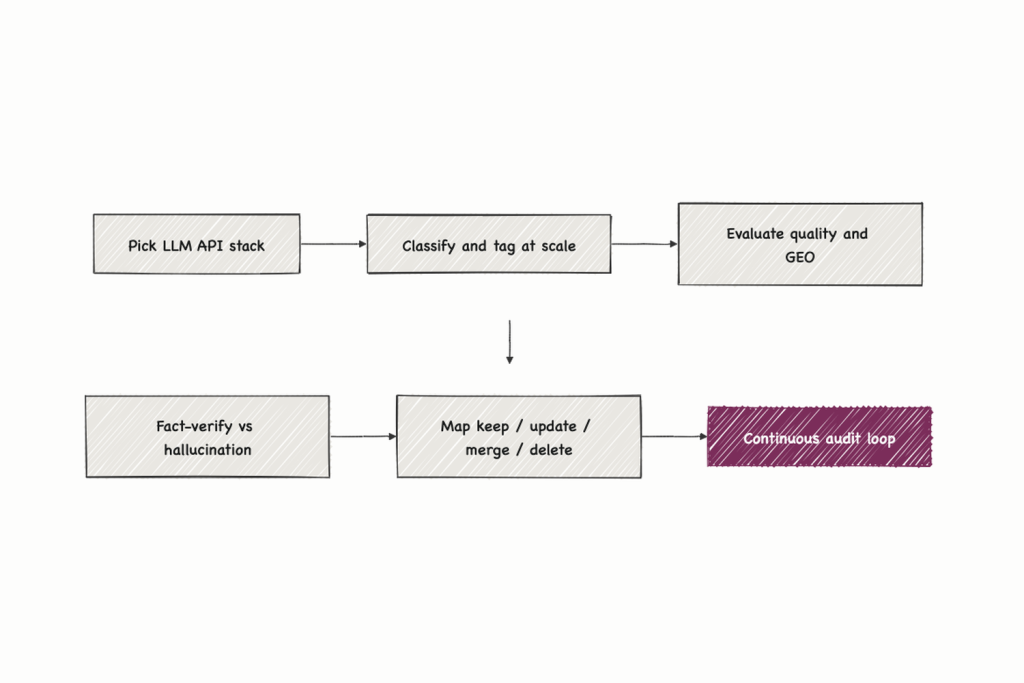
    Building on these rigorous automated checks, execution requires a structured framework to process raw evaluations. How do we turn model analysis into rankings? A modern content audit for seo combines LLM-readiness checks across 70 programmatic criteria—including coverage, structure, and entities—with real-time traffic data (Emilia Moller via LinkedIn). Semrush defines this framework using clear actions: keep, update, consolidate, or prune (Semrush). We map crawler exports to actionable paths.

    Audit Action Core Traffic Rule LLM Evaluation Factor
    Keep as is Exceeds organic targets High information gain
    Update Declining traffic Low citation probability
    Merge / Redirect High semantic similarity Redundant entities
    Prune / Delete Zero traffic Low technical parseability
    • Spell: This programmatic framework synthesizes complex code edits natively through LLMs (arXiv:2602.01107v1).
    • Automatic Maps: Systems programmatically generate clean redirect mapping alongside complex ontology relationships (Medium – Tasos Pardalis).
    • Pruning: Removing digital clutter directly boosts search engine rankings and improves user experience (Contentful).

    Traditional SEO checks only look at historical traffic. However, your site operator must determine whether search assistants will cite your content, which is a key metric in modern LLM-driven audits (EWR Digital). This automated mapping ensures your pages remain highly visible. We can now transition to the actual deployment of these automated strategies.

    Shifting to the Site Operator Loop: Building a Continuous Audit Lifecycle

    Building on this structured automated mapping, real-time content lifecycle management replaces static spreadsheets. Why use outdated snapshots when agentic AI allows active, continuous assurance (Trullion)? Smart systems construct an ongoing “site operator” loop. Landbase Blog reports that 79% of organizations used some level of agentic AI by 2025, and 96% planned to expand operations.

    Modern platforms use traditional scraping infrastructure, including HTTP libraries or headless browsers, to access web pages directly (Medium – Anirudha Kuchibhotla). These background loops run continuously to monitor semantic similarity and guard against content decay.

    How does your team trigger these checks? Micro-audits run programmatically whenever teams publish pages.

    • Instant Session Fixes: Automated systems find stale pages, missing metadata, and terminology drift, letting users fix issues immediately via an AI Content Agent (Sanity.io).
    • Scheduled Validation: The site operator loop handles crawler exports, metadata validation, expired content, and structured outputs (Optimizely).
    • Agentic Frameworks: Modern pipelines deploy tools like LangChain, CrewAI, Microsoft Agent Framework, or LlamaIndex Workflows to run checks (LangChain Resources).

    This continuous cycle ensures your material remains fresh. Continuous monitoring protects your search performance.

    Conclusion: Scalable SEO Mastery with Programmatic Auditing

    Continuous loops replace dead spreadsheets. When content cannibalization quietly destroys your traffic, manual analysis of vector embeddings and cosine similarity fails completely, making automated systems the only logical path forward for modern enterprise websites. Technical teams save hundreds of hours by feeding crawler exports directly into structured outputs with strict json schema controls. This real-time validation stops decay. It prevents indexing issues.

    Will your brand adapt? Legacy platforms cannot handle modern token limits or the complex html parsing required for deep text extraction. To survive, smart SEO leads must deploy a permanent AI site operator to manage redirect mapping, maintain factual accuracy, and maximize information gain across their entire digital footprint. Run your first automated audit today.

    Frequently Asked Questions

    What is the difference between a content inventory and a content audit for SEO?

    A content inventory simply lists existing assets. In contrast, a content audit for seo evaluates performance, quality, and relevance to determine necessary strategic actions for your pages, as noted by Hannon Hill.

    How can I evaluate a site for AI hallucinations and fact-verify claims automatically during an audit?

    To run a programmatic hallucination audit, utilize modern workflows with flexible APIs and AI-first classification systems. This approach automates fact-verification by cross-checking assets against trusted sources. According to Orbiq, automating routine testing reduces manual collection and preparation time by up to 80%.

    How do you run a programmatic content audit for SEO across 1,000+ pages for under $50?

    You can achieve cost-effective auditing by using budget LLM APIs. For example, OpenAI’s Batch API offers a 50% discount, pricing GPT-4o-mini at just $0.075 per million input tokens. This makes running a large-scale content audit for seo highly affordable.

    What actionable frameworks should I use to decide whether to keep, update, delete, or merge a page?

    Utilize a structured content audit for seo to identify critical ‘Content Debt’ like outdated, low-value, or underperforming content. This framework helps you decide whether to keep update delete merge. According to iStudios Media, this process quickly uncovers cannibalized clusters and pages sitting in search positions 4 to 20.

    How do we shift our SEO operations from static annual spreadsheets to a continuous audit loop?

    Transitioning to a continuous content lifecycle relies on an automated site operator. By utilizing pre-built connectors and LLM APIs, you can automate data exchange and classification. According to PwC, adopting these models reduces initial audit review times by up to 30%.


    Written by AWRSHIFT Team

  • The Technical Content Pruning Playbook: Boosting Crawl Budget and Site Quality with an Advanced SEO Site Audit

    Quality auditQuality 84/100SEO 74Human-style 100Sources 2411 min read

    Introduction: The Model Shift in Enterprise Site Architecture

    Content volume no longer guarantees visibility. Historically, enterprise brands scaled organic traffic by flooding search engines with thousands of targeting pages, but modern search algorithms now penalize these bloated directories because they damage your crawl budget and dilute critical quality signals across your entire domain. This bloat is dangerous. Consider the case of QuickBooks. The financial software giant successfully reversed a slow decline in organic traffic by deleting more than 2,000 outdated blog posts from its content library (Source: Animalz). Legacy pages fail. They often turn into zombie pages that fail to meet modern search intent, driving up rendering cost while signaling low quality to search engine site classifiers. Do not hoard dead weight. Instead of keeping this clutter, modern enterprise architectures prioritize lean indexing status to protect valuable link equity.

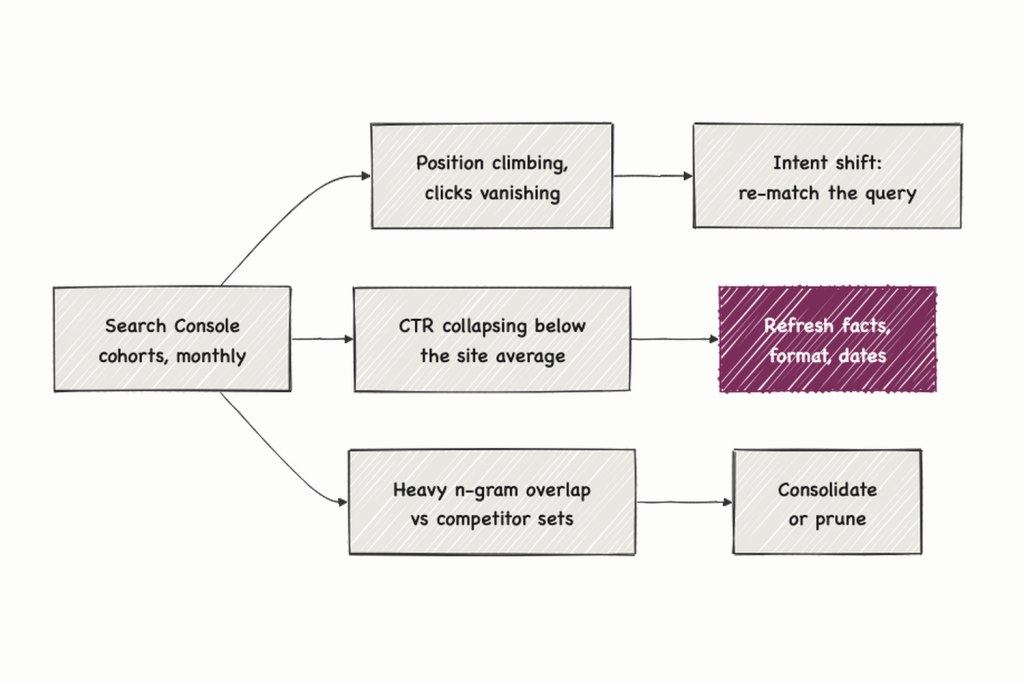
    How do you protect your indexation status? In this strict environment, a modern seo site audit must evolve from a simple checklist into a rigorous, data-driven pruning mechanism. Content pruning is the strategic process of removing, updating, or consolidating low-value, outdated, or underperforming website content to maximize SEO ROI (Source: Grab Your Skill). The financial returns are immediate. They are also highly measurable. Seer Interactive deployed this strategy for an insurance client, reversing a painful -17.3% YoY traffic decline to achieve a +23% YoY increase by pruning low-performing or outdated content (Source: Seer Interactive). Also, Inflow demonstrated that pruning low-performing blog content led to a 64% increase in strategic content revenue for an eCommerce brand (Source: Inflow). Monitor your site constantly. To maintain authority, modern sites must evaluate their citation footprint and analyze server log files to monitor actual crawl frequency because systems that ignore this operational reality will find themselves filtered out of both traditional indexes and generative AI retrieval engines.

    The Algorithmic Engine: Crawl Budget, Index Tiering, and Site-Wide Quality Signals

    Search engines face a hard limit. They must constantly balance their own resource constraints against massive web growth. Googlebot calculates crawl budget as the set of URLs it is willing and able to crawl within a specific timeframe, mathematically determined by multiplying crawl capacity limit by crawl demand (Source: Google Search Central). Rendering JavaScript drives up computational processing requirements. This forces search engines to categorize pages into a strict indexing tier, postponing expensive rendering steps for pages that do not immediately demonstrate value. What does this mean? For large enterprise sites, a high rendering cost directly reduces crawl frequency for your money pages. When robots waste precious CPU cycles on redirect loops, endless redirect chain issues, or utility pages that should remain unindexed, your most valuable content suffers. In fact, Linkbot notes that crawl budget allocation is heavily influenced by domain authority, server performance, and content quality, with thin, duplicate, or low-value pages diluting overall crawl efficiency.

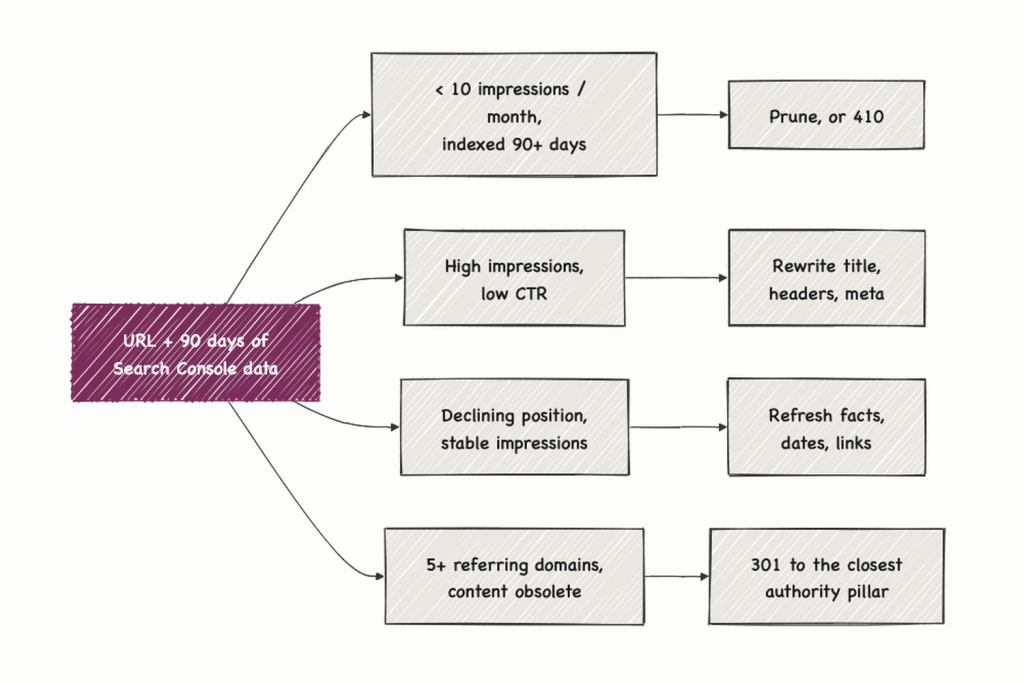
    Diluted efficiency triggers algorithmic downgrades. Google’s automated ranking systems use site-wide signals and classifiers alongside page-level signals to evaluate overall site quality, meaning low-quality sections can drag down the performance of your entire domain (Source: Google Search Central). High-performance pages lose visibility. This happens when they are surrounded by zombie pages that exhibit severe content decay. How does the system identify these weak points? Google’s AI-driven helpful content system uses machine learning to prioritize reliable, people-first information over content created solely for search engine rankings (Source: Google Search Central). This automated site classifier processes your entire digital footprint to measure aggregate quality. If your site houses thousands of outdated pages that lack unique information gain, the algorithm downgrades your authority. Protect your quality signals. Google continues to dominate the global search engine market, holding approximately 80.85% to 90.04% of the global search traffic market share (Source: Omnibound). Every seo site audit must therefore use a strict decision tree to evaluate whether underperforming URLs should be consolidated, redirected, or pruned to protect overall link equity. Keep your directories clean. Otherwise, you open the door to competitors.

    Generative Engine Optimization (GEO) and the LLM Citation Footprint

    Building on this algorithmic pruning, the modern seo site audit must now adapt to a massive structural shift in organic visibility. Traditional link-based indexing is rapidly giving way to Large Language Model (LLM) training set ingestion. This transition is incredibly stark. Indeed, zero-click searches have risen to 68% of US Google queries, while traditional search volume is predicted to drop by 25% as users shift to AI-powered answer engines (Source: Search Engine Land). Generative Engine Optimization (GEO) is the practice of structuring and refining digital content to perform well and be accurately summarized by AI-driven search engines (Source: Coursera). How many sites survive this transition? Only 11% of websites are currently cited by LLMs, with brand search volume (+0.334 correlation) and backlinks (+0.169 correlation) serving as top predictors of LLM citations (Source: The Digital Bloom).

    Factors Influencing LLM Citations (The Digital Bloom):
    - Brand Search Volume (+0.334 correlation)
    - Backlinks (+0.169 correlation)

    Protecting your brand equity within AI-generated summaries requires exceptional data integrity. Research shows that 50% to 90% of LLM responses are not fully supported or are contradicted by their sources, and LLMs achieve only a 4% to 18% accuracy rate in identifying correct citation matching (Source: PubMed Central PMC12003634). Clean structured data and rich information density prevent these hallucinations. Writers must optimize for several key ranking factors:

    • URL accessibility and SEO rank
    • Fan-out rank and query-answer match
    • Presence in Common Crawl, Wikidata, or Reddit (Source: LinkedIn/Chris Long)

    Adding expert quotes, clear statistics, and improving readability can significantly boost visibility in generative engine results (Source: Princeton University via Reddit GrowthHacking). This ensures your citation footprint remains intact. These optimization steps are mandatory for modern brand survival.

    The Practical Classification Framework for Enterprise Content

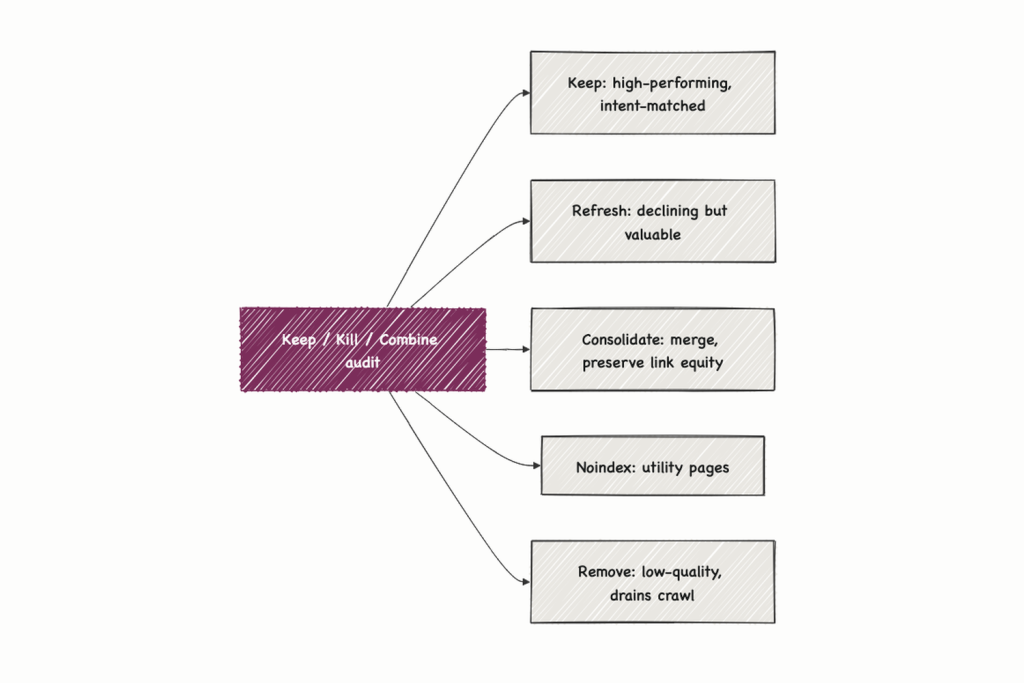
    Building on this shifting citation footprint, a modern seo site audit must systematically evaluate how human and machine-generated assets perform. Your team cannot rely on intuition. Decisions within a content pruning framework must rely on objective, multi-source data and diagnosis rather than gut feeling, evaluating gaps in content, traffic performance, and social signals (Source: SEO-Kreativ). How do we classify these vast digital libraries? Managing this scale requires content lifecycle management (CLM), which is a systematic six-stage approach (planning, creation, management, distribution, optimization, and preservation/retirement) to manage content assets (Source: Strapi). A structured content audit decision tree, such as the Keep/Kill/Combine framework, converts raw data into clear actions: Keep, Refresh (Update), Consolidate (Combine), Noindex, or Remove (Source: SEO-Kreativ).

    • Keep: Protect high-performing assets that match search intent.
    • Refresh: Update declining resources to capture new organic traffic.
    • Consolidate: Merge redundant articles to preserve link equity.
    • Noindex: Hide utility pages while keeping them accessible.
    • Remove: Prune low-quality URLs that drain rendering cost.

    Actionable categorization prevents algorithmic stagnation. Updating and keeping content fresh through regular optimization can result in up to 106% growth in organic traffic (Source: HubSpot via Bynder). That is a massive return on existing assets. Conversely, ignoring your zombie pages degrades the indexation status of critical pages. These zombie pages are indexed pages that provide little to no SEO value or traffic; they can be identified in Google Search Console as URLs with zero clicks and very low impressions (Source: TDIT Group). Why do they exist? These assets often consist of pagination pages, category pages, or indexation discrepancies where search engines index far more pages than the site’s meaningful content count (Source: Taylor Joseph Scher via LinkedIn). Your audit must isolate these dead-weight URLs by cross-referencing server log files with current traffic. This keeps your domain healthy. Let us look at how these technical steps translate into actual site authority.

    Technical Execution Strategy: Redirects, Status Codes, and Noindex

    Building on this classification framework, executing a technical seo site audit requires precise server-side execution to clean up indexation discrepancies. Actionable code selection prevents crawler confusion. Every hop in a redirect chain adds latency, depletes the crawl budget, and dilutes PageRank, making redirect chain cleanup a critical technical task (Source: Siteimprove). Why tolerate this structural drag? Eliminating these multi-stage hops immediately improves crawl frequency and reduces rendering cost. When multiple pages compete for the same search intent, a 301 redirect is the preferred option, allowing the site to capture and pass on valuable backlinks and traffic (Source: Reddit r/TechSEO). Conversely, keeping dead weight online degrades your site classifier. A 410 Gone status code is highly effective and ideal for signaling to search engines that a page is permanently deleted with no equivalent replacement, ensuring faster removal from the index (Source: Shopcircle). Selecting the correct server response ensures search engine crawlers spend time only on high-performing, valuable URLs.

    Redirect and Status Code Protocols:
    - 301 Redirect: Consolidates duplicate search intent and preserves backlinks (Source: Reddit r/TechSEO)
    - 410 Gone: Signals permanent deletion for faster index removal (Source: Shopcircle)
    - Noindex Tag: Restricts utility pages from indexing while maintaining user access (Source: GSQI)

    Link reclamation targets previously removed or broken backlinks to maintain SEO equity, recovering valuable PageRank that would otherwise be lost when Google recalculates authority (Source: WooRank). This process protects your citation footprint. However, pruning decisions must not be based on traffic alone; technical audits must evaluate internal and external linking, multi-channel traffic, and sitemaps to avoid reducing total visibility (Source: Marco Giordano via LinkedIn). Your team must review log files to see how search bots interact with these changes. To address low-quality or thin content, webmasters should either improve, noindex, or permanently remove the content depending on its volume and potential value (Source: GSQI). This systematic approach preserves link equity while keeping your indexing tier clean. Applying these protocols prevents redirect loops and protects organic traffic. This technical hygiene prepares your architecture for advanced optimization.

    Post-Pruning Metrics and Governance Models

    Post-pruning verification turns temporary traffic spikes into permanent authority. How do webmasters validate the success of a technical seo site audit? Search Engine World explains that a modern content audit uses Google Search Console, crawlers, and log data to triangulate and identify underperforming pages that are quietly hurting site performance. Examining your raw log files reveals immediate shifts in search bot behavior. Crawlers shift their focus away from dead weight, which reduces rendering cost and increases crawl frequency on high-performing URLs. This redistribution of resources directly raises the indexing tier of your remaining core pages. Have you seen an increase in organic traffic? Monitor the indexation status of your main categories to confirm that Google has stopped crawling zombie pages. Watch for any accidental redirect loops or a broken redirect chain that could leak link equity. Additionally, tracking LLM visibility metrics daily can help detect SEO content decay early, though Wellows notes that data-driven ground truths are preferred over LLM-as-a-judge methodologies.

    • Log file analysis: Confirms crawl budget redistribution.
    • Indexation status monitoring: Verifies the removal of zombie pages.
    • Authority tracking: Measures organic lift on remaining core pages.

    Preventing future content bloat requires strict governance policies. Conductor outlines that content pruning is executed as a strategic three-step process: creating a complete Content Inventory, conducting a Content Audit, and implementing subsequent actions. Do not let your site slide back into decay. Enterprise content lifecycle policies, such as those in Egnyte’s Secure & Govern, are utilized to define document retention, deletion, and archival settings systematically (Source: Egnyte). These automated rules prevent useless utility pages from accumulating over time. Every new piece of content must demonstrate unique information gain to justify its creation. This strict gatekeeping protects your citation footprint and maintains a strong site classifier. What happens to pages that fail to meet performance targets within six months? A clear decision tree must route them to be merged or assigned a 410 status code. Consistent enforcement of these boundaries keeps your digital architecture lean, fast, and optimized for search engine bots. Learn more about automated content maintenance to protect your rankings.

    Frequently Asked Questions

    What is Technical SEO auditing and issue detection in the context of content pruning?

    Technical SEO auditing and issue detection serve as the foundation for successful content pruning. This process identifies thin, duplicate, or low-value pages that dilute crawl efficiency, as noted by Linkbot. Addressing these issues allows enterprise sites to reverse traffic declines and boost organic performance (Seer Interactive).

    How do site-wide quality signals impact high-quality pages during an seo site audit?

    During an seo site audit, it is vital to address site-wide quality signals. Google Search Central explains that automated quality classifiers evaluate overall domain quality, meaning low-quality sections can drag down high-performing pages. Pruning underperforming content ensures these site-wide metrics do not suppress your best content.

    When should an SEO manager choose a 410 Gone status code over a 301 redirect?

    During content pruning, an SEO manager should use a 410 Gone status code for outdated pages with no equivalent replacement or link equity. Unlike a 301 redirect, which passes authority to a new URL, a 410 tells search bots the page is permanently removed, preserving your crawl budget.

    How does pruning low-information-gain pages support Generative Engine Optimization (GEO)?

    Removing low-information-gain pages helps focus search engines on high-quality content optimized for Generative Engine Optimization (GEO). Since only 11% of websites are currently cited by LLMs, streamlining your site increases the chance of securing an LLM citation by highlighting expert, readable content (The Digital Bloom).

    What is the best way to measure crawl budget improvements after executing an audit?

    The most accurate way to measure crawl budget improvements is through log file analysis to track search bot behavior. Combining log data with the GSC API using Python allows you to programmatically verify if search engines are focusing more attention on your high-value pages.


    Written by AWRSHIFT Team