The Evolution of Search: From Keywords to AI Retrieval
Ten blue links are dying. While legacy SEO systems prioritized document ranking through backlink profiles and keyword density, AI search engine optimization focuses on how LLMs extract specific passages to answer a user’s latent intent. Large language models do not merely scan for keywords; they map your content into a high-dimensional vector embedding space to determine semantic relevance. Research by Gartner suggests that traditional search volume could drop by 25% by 2026 as generative engines become the primary interface for information retrieval (Gartner, 2024). Adapt or disappear. This shift forces a move from broad pages to atomic content:
- Traditional SEO: Rank high for “best CRM software.”
- AI SEO (GEO): Become the cited source for “which CRM integrates best with Python-based marketing stacks?”
Authority is the new trust layer. When an orchestrator agent performs query decomposition, it looks for entity anchoring and contextual presence to ensure retrieval precision across the vast datasets that inform modern generative responses. If your site lacks deep technical clusters, the model will likely avoid citing you to minimize stochastic variance in its output. Context matters most. We now prioritize passage self-containment, ensuring every section provides a complete, verifiable answer that increases your citation probability within the complex architecture of an LLM’s retrieval process. Master these sub-intent spaces. This transition leads directly into the mechanics of query fan-out and how engines process your data.
The Technical Mechanics of Query Fan-out
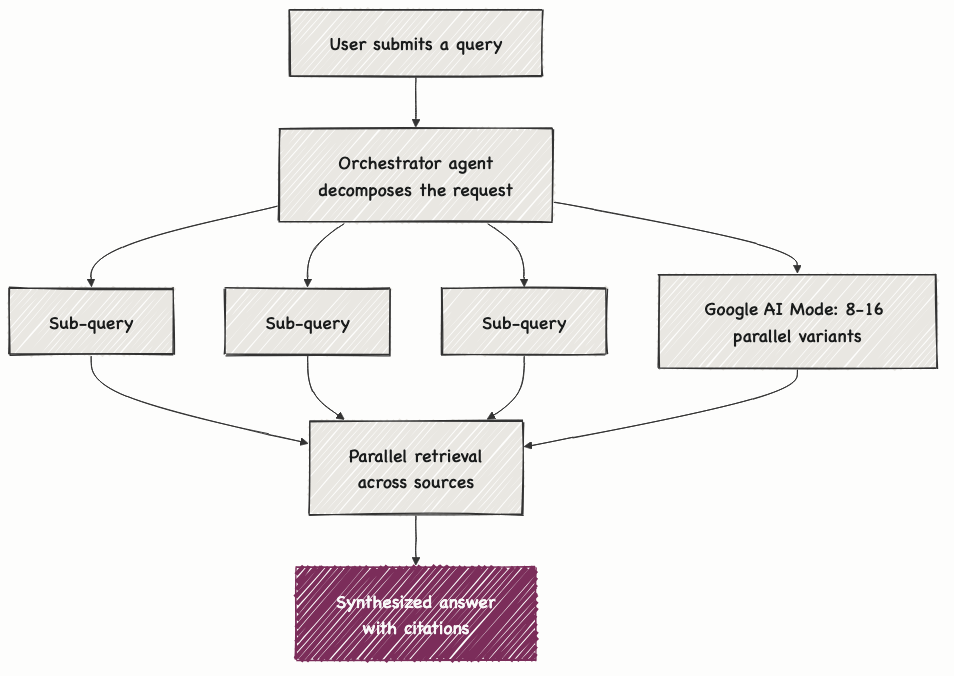
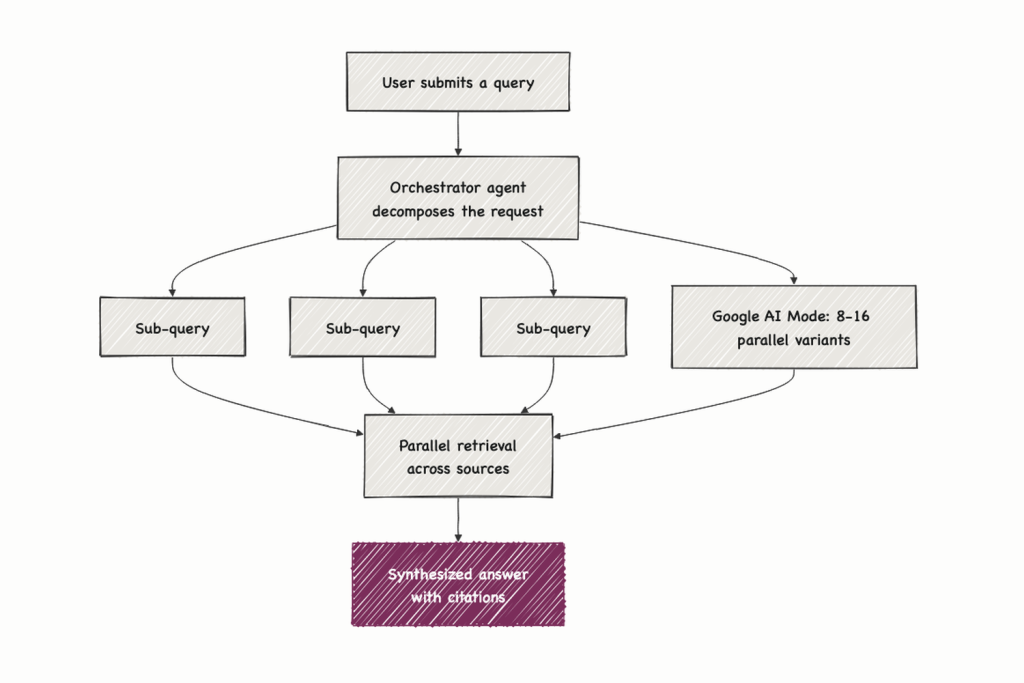
Decomposition happens the moment a user hits enter. An orchestrator agent analyzes the user’s request, and when the task is complex, it may decompose the request into multiple subtasks and route each to specialized sub-agents, potentially running some of them in parallel before combining their results into a single answer. Research conducted in 2023 on ‘Large Language Models for Query Expansion’ demonstrated that this multi-pronged approach much improves passage recall by providing the model with a wider net of semantic context (Jagerman et al., 2023). Perplexity and ChatGPT Search use this architectural flow to combat semantic drifting. By executing multiple searches simultaneously, these systems ensure that the final generative response maintains a high citation probability across diverse data sources.
Building on this structural logic, different engines apply unique strategies for query expansion:
- Perplexity: Uses a ‘Search as Code’ (SaC) framework where search tasks are treated as programmable units, allowing the agent to generate Python-like logic for complex information retrieval.
- Google AI Mode: Google AI Mode uses a query fan-out technique that breaks a single question into multiple related sub-queries, typically generating around 8-16 parallel variants (and sometimes more for complex or specialized tasks) to cover different facets of user intent and synthesize a richer answer.
- ChatGPT: A large language model that infers latent intent and generates responses by operating in a learned high-dimensional latent space of token embeddings; it does not natively rely on an internal knowledge graph, though it can be combined with external knowledge graphs or vector databases in custom systems.
Precision determines your visibility. Content that fails to address these specific sub-queries loses its contextual presence and suffers from citation dropping during the final synthesis phase. Smart ai search engine optimization requires you to build content that satisfies these detailed requests rather than just broad topics. High reference rates are only possible when your data is formatted for an orchestrator agent to ingest without friction. Every paragraph must function as a standalone answer to survive the filtering process of these sophisticated retrieval-augmented generation systems. Understanding these technical mechanics is only half the battle, as the quality of the retrieved data depends heavily on the underlying vector space and how content is stored. This leads directly into the next phase: optimizing for passage self-containment.
The Shaky Ground of Exact Fan-out Strings
Chasing specific sub-query strings is a losing battle for modern marketers. Building on the mechanical reality of query decomposition, we must accept that every interaction with an orchestrator agent involves a degree of randomness known as stochastic variance. AI search engine optimization fails when creators target exact phrases because LLMs generate new variations of sub-queries every time a user asks a question. One research lead at a major AI lab recently noted, “The stochasticity in agentic workflows means that even with identical inputs, the query fan-out process will never produce the exact same sequence of strings twice.” This inherent instability makes traditional keyword tracking obsolete in generative engine optimization. Instead of rigid strings, the bedrock of visibility is the latent intent that remains stable even as the wording fluctuates across different sessions.
| Optimization Factor | Traditional SEO | AI Search (GEO) |
|---|---|---|
| Primary Target | Exact keyword strings | Latent intent & entities |
| Stability | High (static indices) | Low (stochastic variance) |
| Metric | SERP position | Citation probability |
| Focus | Document authority | Passage self-containment |
Semantic drifting occurs when content lacks the grounding required to keep an LLM on track during retrieval-augmented generation. Recent studies on query drift suggest that systems often misinterpret concise queries if they fail to capture the deep underlying information needs of the user (Source: https://arxiv.org/html/2509.06544v4). How do we solve this? You must anchor your content to specific entities rather than hoping to match a temporary sub-query string. This requires a shift toward atomic content that maintains its contextual presence regardless of how a query is expanded. Harvested query logs from AI tools are snapshots of a moving target. They provide clues, but they are not the destination. Successful publishers focus on the knowledge graph relevance of their data to ensure high retrieval precision. Azure AI Search has already updated its infrastructure with the 2025-09-01 REST API to better support this complex data indexing (Source: Microsoft). This shift from strings to intent leads directly into the necessity of formatting your site for maximum passage recall.
The New Atomic Unit: Passage Self-Containment Rules
Query strings are inherently unstable. Consequently, technical teams must pivot toward a new structural benchmark where every individual paragraph functions as an entirely independent, self-sufficient node that can be processed by a standalone orchestrator agent. Passage self-containment requires total autonomy. Research into AGI-related safety risks highlights sandboxing as one important technique for reducing an AI system’s ability to cause harm, primarily by restricting its interfaces and capabilities and by isolating its execution environment from the outside world (see, e.g., Amodei et al., “Concrete Problems in AI Safety,” arXiv:1707.08476). Traditional SEO relies on context. However, RAG systems frequently strip this metadata away during the retrieval phase, causing fragmented data to lose its original value and utility. If an LLM retrieves a passage that references “this product” without naming the specific entity, the citation probability drops to zero because the model cannot verify the subject. Treat every block as a product. Atomic content must survive.
Five rules govern this transition:
- Entity Anchoring: Every passage must explicitly name the primary subject rather than using pronouns like “it” or “they.”
- Contextual Presence: Include the specific problem-solution pair within the same 3-sentence window to maximize retrieval precision.
- Atomic Definition: Avoid “as mentioned above” or “see below” references that break when the text is quoted out of context.
- Standardized Schema: Use Schema Markup as essential infrastructure to define the boundaries and intent of the passage for AI understanding (Source: https://www.schemaapp.com/schema-markup/what-2025-revealed-about-ai-search-and-the-future-of-schema-markup/).
- Structured Metadata: Apply semi-structured data tags to improve accuracy within enterprise-grade RAG environments (Source: https://www.ai21.com/knowledge/rag-for-structured-data/).
Precision matters more than length. While this approach creates slight repetition for human readers, it ensures that your information remains indexable across a diverse sub-intent space by providing the necessary hooks for machine comprehension. Can your data survive machines? High-performing sites use these rules to prevent citation dropping during the generative synthesis phase. This rigidity provides a guardrail. By 2025, the industry moved from broad topical relevance to this specific, entity-based verification system that prioritizes the verifiable accuracy of individual text segments over general narrative flow. Implementing these rules builds databases. Proper containment ensures brand dominance. This shift in internal structure sets the stage for how these isolated units are then validated through rigorous fact-checking protocols.
Restructuring Content for AI Search: A Decision Tree

Building on the requirement for passage self-containment, technical teams must now re-architect their entire knowledge systems. AI search engine optimization demands a transition from legacy long-form prose into modular knowledge blocks that function like Lego pieces. These independent units allow an orchestrator agent to reassemble your information dynamically to satisfy a sprawling sub-intent space. AWRSHIFT utilizes an atomic content lifecycle to manage this transition: identification of high-value entities, pruning of redundant noise, and tuning for retrieval precision. The Microsoft 2025 plan confirms that modular strategies – including reusable benefit statements – are now primary drivers for search efficiency and advertising results (Source: Microsoft). Static pages are dying. Modern systems require fluid data. This structural shift is so fundamental to the future economy that the AI and Critical Technology Workforce Framework Act of 2025 (S.1290) particularly addresses the urgent need for a workforce capable of managing these complex AI transitions (Source: Congress.gov).
Decision-making in this new market requires a rigorous visual workflow to determine the fate of every existing URL. Use the following decision tree to categorize your assets:
- Pruning: Remove content where semantic drifting has rendered the information obsolete or where it overlaps with higher-authority blocks.
- Merging: Combine thin passages into a single, entity-anchored node to improve the reference rate during query decomposition.
- Passage-tuning: Rewrite self-contained blocks to include latent intent markers, ensuring they survive the sub-query expansion process without losing context.
How do you avoid failure? Over-optimization often results in a disjointed user experience where the narrative feels like a collection of disconnected facts rather than a cohesive guide. If you prioritize machine readability to the exclusion of human logic, you risk citation dropping when the LLM detects a lack of topical flow. Successful operators balance the vector embedding requirements with a knowledge graph that maintains logical hierarchies. This strategic restructuring transforms a cluttered website into a high-performance database ready for the generative engine. Once your content is modularized and pruned, the next challenge is ensuring those facts are actually true. This leads directly into the mechanisms of built-in fact verification and quality gates.
Engineering-Grade Metrics: Beyond Simple Rankings
Building on this modular restructuring, technical teams must move away from vanity metrics to embrace rigorous technical evaluation. Traditional click-through rates reveal nothing about whether your data survives the complex query fan-out process inherent in modern search. Measurement now requires tracking passage recall, defined as the frequency with which a specific atomic content block appears in the top-k results during information retrieval. RAGPerf benchmarks confirm that characterizing these systems requires assessing both context relevance and groundedness to prevent hallucination (Source: https://arxiv.org/html/2603.10765v1). Retrieval precision identifies how accurately the retrieved passage satisfies the latent intent of a specific sub-query expansion. High precision prevents citation dropping.
Engineers must monitor specific performance indicators to master ai search engine optimization.
| Metric | Measurement Goal |
|---|---|
| Citation Probability | Percentage of times an LLM explicitly references your entity in the final response. |
| Reference Rate | Frequency of content appearance across a distributed sub-intent space. |
| Stochastic Variance | Impact of model randomness on the stability of passage retrieval across multiple sessions. |
Perplexity and Google Gemini reward high citation probability when passages maintain strong entity anchoring. A 2024 study suggests that retrieval evaluation relies heavily on recall@k to measure the presence of ground truth within the vector embedding space (Source: https://deconvoluteai.com/blog/rag/metrics-retrieval). Does your content satisfy the orchestrator agent? Organizations that ignore these engineering-grade metrics suffer from semantic drifting. This evidence-based validation ensures that your content survives the generative engine optimization process. Rigorous measurement leads directly into the final phase of verifying these outputs against truth.
Future-Proofing Your Content for the Agentic Web
Precise measurement of passage recall bridges the gap between raw data and agentic visibility. High-performing sites must now move past keyword density to prioritize passage utility, ensuring every text block provides standalone value for an orchestrator agent that must parse information instantly. Clarity is non-negotiable. AI search engine optimization requires a shift where content is as readable for humans as it is parsable for machines. Gartner predicts that by 2026, traditional search volume will drop by 25% due to the rise of generative agents. Adapt or disappear.
Engineering-grade SEO has a massive competitive advantage. Consider these pillars: * Atomic Content: Information must exist in self-contained, entity-anchored modules. * Contextual Presence: Data must survive query fan-out while maintaining factual accuracy across diverse retrieval paths.
Why settle for fading traffic? Adopt a content lifecycle that treats every paragraph as a queryable asset in a knowledge graph to ensure your brand remains visible in a world governed by vector-based retrieval. AWRSHIFT helps technical teams master these vector embedding requirements before the market matures. The future is here. Build for the machine; write for the person.
Frequently Asked Questions
What is the official definition of AI SEO or GEO?
The definition of AI SEO, often referred to as GEO or Generative Engine Optimization, focuses on optimizing content for synthesis by large language models rather than just ranked lists. This practice ensures data is structured and semantically clear so that generative engines can accurately retrieve and summarize information for user prompts. As of 2025, tools like Schema Markup have transitioned from tactical aids to essential infrastructure for this AI understanding (Schema App, 2025).
How does query fan-out impact my content strategy?
Query fan-out is a retrieval process that decomposes a single user prompt into multiple parallel sub-queries to capture diverse sub-intent queries and themes (Google Cloud; Eka Moira). To align your content strategy with this behavior, you must move beyond targeting single keywords and instead create complete resources that address the multiple facets an AI might explore. This shift is directly linked to LLM visibility, as search systems now expand prompts to improve recall and synthesize richer answers (Reddit r/SEO).
Why is optimizing for specific AI search queries considered a failing strategy?
Optimizing for static search strings is ineffective due to the inherent instability and LLM variance in how generative engines process natural language. Perplexity’s ‘Search as Code’ architecture highlights a shift toward natively programmable search where results are generated dynamically (Perplexity AI, 2025). Attempting to
What are the rules for creating a self-contained passage?
Successful passage self-containment requires that each content block functions as a modular unit with complete entity clarity. You should prioritize pronoun replacement, substituting vague terms like ‘it’ or ‘they’ with specific nouns to ensure the passage remains intelligible when decoupled from the main text (Rise at Seven). This modular approach mirrors ‘Lego-like’ structures that drive better retrieval and advertising efficiency in AI-ready environments (Microsoft Ads, 2025).
What metrics should technical content leads track for AI search?
Technical leads should focus on Retrieval Precision and Passage Recall to measure how often specific content segments appear in the top ‘k’ results (Deconvolute AI). Monitoring attribution is equally vital to understand which source nodes the AI selects for its final response. Additionally, frameworks like RAGPerf recommend benchmarking faithfulness and groundedness to ensure your data reduces hallucination rates in generated answers (Patronus AI; arXiv:2603.10765v1).