The Silent Erosion: Why Content Decay is the New Ranking Killer
Winners rot fast. High-volume editorial sites bleed organic traffic not because of technical errors, but through the slow, invisible process of content decay that erodes visibility one page at a time. Traditional SEO audit services usually fail here. They treat a website as a static map rather than a living system that needs constant pruning and surgical updates to stay relevant. When search intent shifts or a quality classifier updates, once-dominant articles become stale winners: they occupy space without capturing share. And in a library nobody actively manages, that rot compounds. Overlapping pages accumulate, keyword cannibalization creeps in, and the site slowly ends up competing against itself for a shrinking pool of intent.
Maintenance is active work, not a one-time cleanup. The split between a checklist audit and content lifecycle management shows up fast:
- Standard Audits: Fix broken links, update meta tags, and check robots.txt.
- Lifecycle Operators: Monitor n-gram overlap, track citation frequency in AI overviews, and merge declining assets.
When clicks drop, the cause is usually a mismatch between the original text and what searchers now expect to find. Catching that gap early, before Search Console shows a full collapse, is the whole game. The signals that expose it are where recovery starts.
Phase 1: Distinguishing Technical Health from Content Performance
A technical SEO audit isolates technical debt before you touch content quality. Large-scale publishers frequently mistake a drop in impression share for a content problem when search bots are actually trapped in poor site architecture or slow server responses. Technical health rests on five pillars: crawlability, indexability, site architecture, page performance, and security. Ignore those basics and you cap your potential ROI no matter how good the writing is.
- Standard Technical Checks: Core Web Vitals measure LCP, INP, and CLS against Google’s documented thresholds, LCP within 2,500 ms and INP under 200 ms, sorting URLs into Good, Needs improvement, or Poor, while robots.txt and sitemap audits ensure Google can actually find your pages (Google Search Central).
- On-Page Hygiene: An on-page SEO audit keeps meta tags, headers, and keyword placement clean to avoid sending mixed signals to the quality classifier.
- Automated auditing: Tools like Semrush can flag technical gaps across thousands of URLs at once, so site operators are not checking pages by hand.
Clearing these errors is non-negotiable. You cannot measure search intent or return on refresh while page experience drags down the entire domain.
Rank tracking data stays noisy until the foundation is solid. SEO audit services that skip the distinction between “can Google see this?” and “does Google like this?” waste thousands of dollars on editorial updates that never get indexed. Picture a site with perfect articles and a five-second load time: the content never gets a chance to compete in an AI overview or earn a citation. Site management starts by fixing the plumbing before painting the walls. Once the technical floor holds, the question shifts to how Google judges the actual value of your information, which is where content scoring and internal linking come in.
Identifying Measurable Decay Signals in the Post-HCU Era
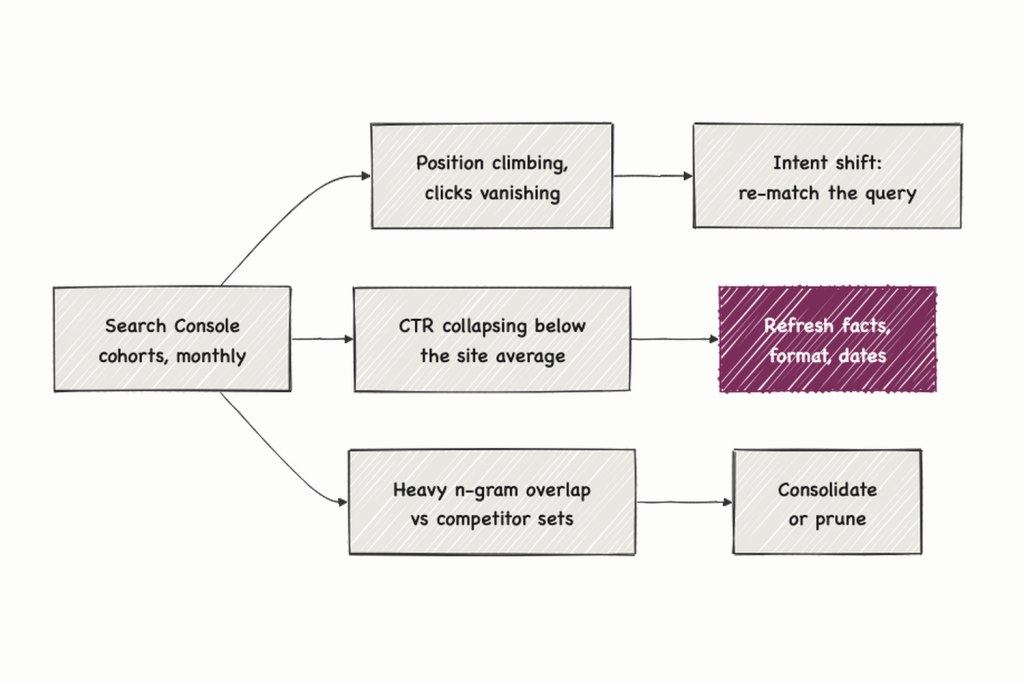
With the technical baseline in place, site operators have to face how Google now judges quality. Google folded the Helpful Content Update classifier into its core ranking systems with the March 2024 core update, so recovery no longer waits for a named update cycle. According to Google, that update cycle was projected to cut low-quality, unoriginal content in results by 40%; once the rollout completed in April 2024, the company reported the actual reduction at 45%. The quality classifier evaluates your domain continuously, and it penalizes pages that show heavy n-gram overlap with existing training data or competitor sets. Language patterns give a page away. When SEO audit services ignore these linguistic footprints, they miss the main reason a page loses its edge despite “optimized” metadata. Research from the EMNLP 2024 Rusty-DAWG study shows that model-generated text reuses long n-grams far more than human writing does (Merrill, Smith and Elazar), so high n-gram overlap usually signals a lack of original reporting rather than bad luck. Screaming Frog lets teams audit these phrase frequencies across thousands of URLs at once to find patterns of content thinness.
| Signal Category | Measurement Tool | Impact on Content Lifecycle |
|---|---|---|
| Phrase Redundancy | Screaming Frog N-Grams | Triggers quality classifiers for lack of novelty |
| Intent Mismatch | Search Console GSC Cohorts | High impressions with tanking CTR indicates decay |
| AI Footprints | Perplexity/GPT Classifiers | Reduces citation frequency in AI overviews |
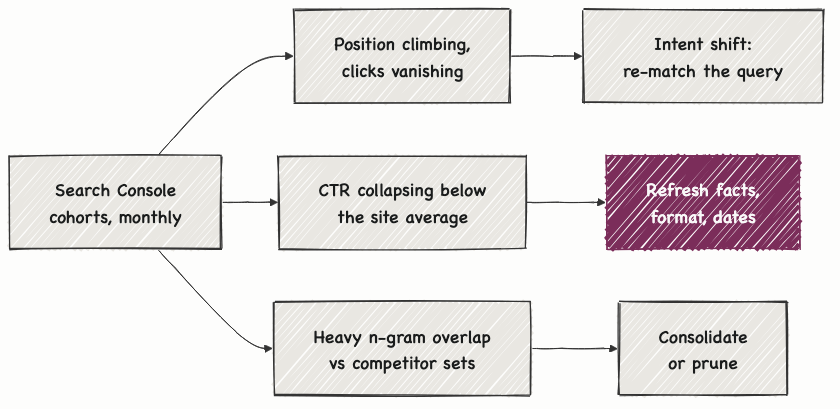
GSC cohorts expose the most dangerous form of decay: the position improvement paradox. A page climbs in average position while total clicks vanish. It happens when the page loses its primary intent match but starts ranking for thousands of low-intent, long-tail queries it cannot convert, so the average-position line rises even as click-through quietly collapses. Search volume turns into a vanity metric the moment the user wants a video and you hand them a 2,000-word essay.
Detecting these shifts calls for a Google Search Console SEO audit that segments your data by query type to find where impression share stays high but relevance has dropped. Stale winners are easy to spot: high-impression pages with a CTR two standard deviations below the site average. Effective site management uses these signals to trigger a content refresh or a strategic merge before the page experience score drags the whole folder down. Internal linking cannot save a page the quality classifier has already marked unhelpful. This evidence-based read moves the strategy from guesswork to engineering, and it sets up the harder question of intent.
A Closer Look: Intent Shift as the Primary Driver of Decay
Intent is the deepest driver of decay, and the hardest to see. Search intent is shifting from keyword matching toward conversational, semantic queries handled by AI engines, and static pages collapse when a once-informational query turns commercial or transactional. Your page can stay technically perfect and still vanish because it no longer solves the user’s immediate problem. In the era of AI Overviews, that loss tends to arrive fast rather than gradually: an answer surfaced directly on the SERP can strip a page’s clicks almost overnight. SEO audit services that ignore these shifts in behavior leave sites exposed to “intent voids” where impressions hold high but clicks disappear.
Intent decay tends to follow three distinct paths:
- Feature Displacement: Google inserts interactive widgets or AI Overviews that answer the query on the SERP, making your long-form guide redundant.
- Format Evolution: Users move from text-heavy analysis to video or short-form data tables, pulling click-through rate down on legacy articles.
- Direct Answer Dominance: AI-generated answers cover “how-to” facts directly, which pushes the strategy toward high-value, opinion-led content that machines cannot replicate.
Strategic site management maps your top URLs against these patterns to gauge the return on refresh. Stale winners often fall to format evolution because they lean on 2021-era structures in a 2024-era market. Keyword cannibalization hides behind these shifts too, when several pages fight over a fragment of a shrinking intent pool. The real decision is whether a page needs a total rewrite or a simple format adjustment, and getting that right is what protects impression share. Aligning what the user asks with what the page delivers keeps your content eligible as a primary source for answer engines, and it feeds directly into the editorial execution below.
The Monthly Triage Workflow: Refresh, Prune, or Leave-Alone
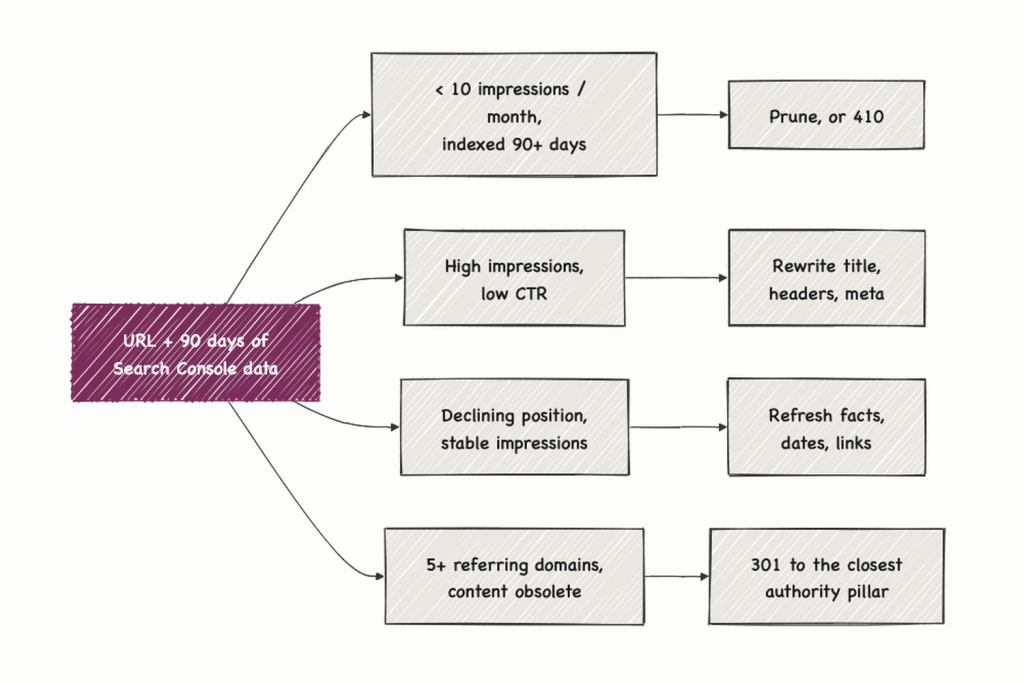
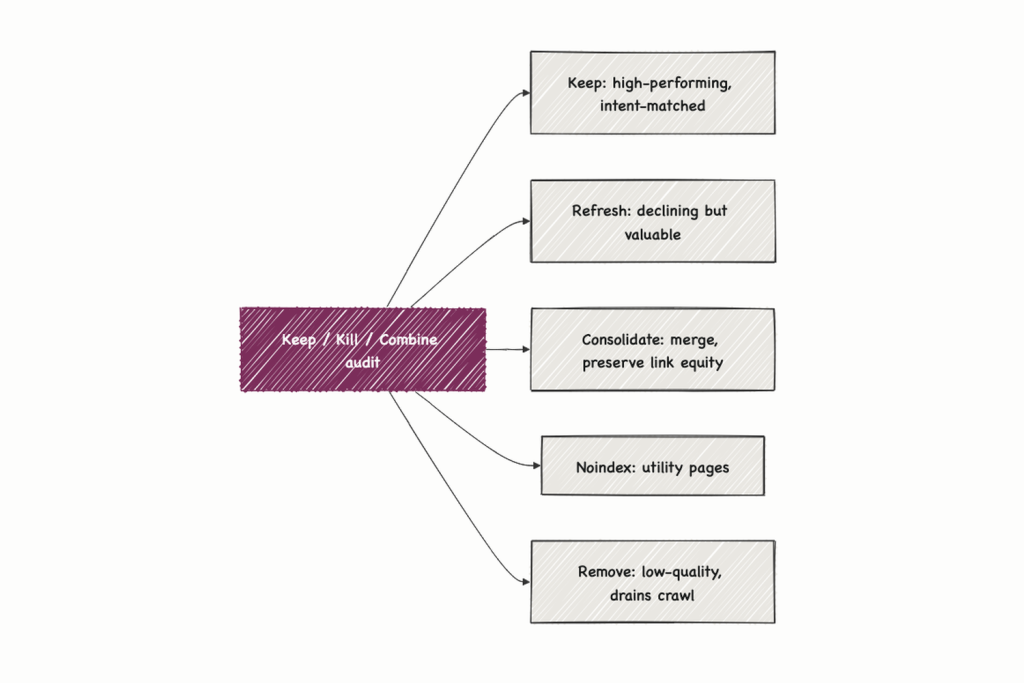
Efficiency decides who survives a crowded market. Once semantic alignment is handled, site operators need a triage system to manage the content lifecycle across thousands of URLs. The tactical decision follows a strict logic flow: Refresh, Consolidate, Noindex, or Remove. Pages with high impression share but declining rankings are prime refresh candidates; pages with zero traffic and high n-gram overlap against better assets are pruning candidates. A standard SEO audit services framework ranks these fixes on a tiered P1-P3 scale by business value and severity. A stale winner from 2022 might need only a data update to recover its position, while a thin page on a redundant topic should be removed to lift the domain’s overall quality classifier. Automation carries the repetitive load: software-driven audits clear these mechanical checks quickly, which frees the team for high-impact editorial work instead of spreadsheet upkeep.
Return on Refresh (RoR) is the mental model that justifies each month’s budget allocation. It weighs the cost of updating a page against the traffic that page can realistically recover.
| Action Category | Decision Driver | Cost vs. Benefit |
|---|---|---|
| Refresh | High search volume but declining rank tracking | Established crawl history and links make refresh cheaper and faster than a net-new build |
| Consolidate | Keyword cannibalization across 3+ URLs | Higher complexity; prevents internal ranking conflicts |
| Prune | Zero clicks in 12 months; poor page experience | Low cost; boosts site-wide quality signals immediately |
Refreshing an existing asset is generally faster and lower risk than launching a new production cycle from scratch. New content often faces a “sandbox” period where visibility is uncertain, while a refreshed page already carries a crawl history and an established internal linking structure. Quarterly decay audits matter in competitive niches, keeping citation frequency in AI overviews high while competitors scramble to catch up. Treat content as a depreciating asset that needs regular maintenance to avoid total failure. That shift from manual guessing to engineering-grade triage is what makes every dollar spent on a refresh trace back to measurable traffic. Once you know which pages to save, the work moves to the technical execution of those updates.
Scaling Content Longevity through Systemic Audits
Surgical updates turn static libraries into active growth engines. Content assets depreciate like physical machinery, steadily losing organic value without active reinvestment. Left alone, top-tier pages wither. The Return on Refresh model quantifies which URLs hold the highest recovery potential, so teams can prioritize the updates that restore impression share and click-through rate.
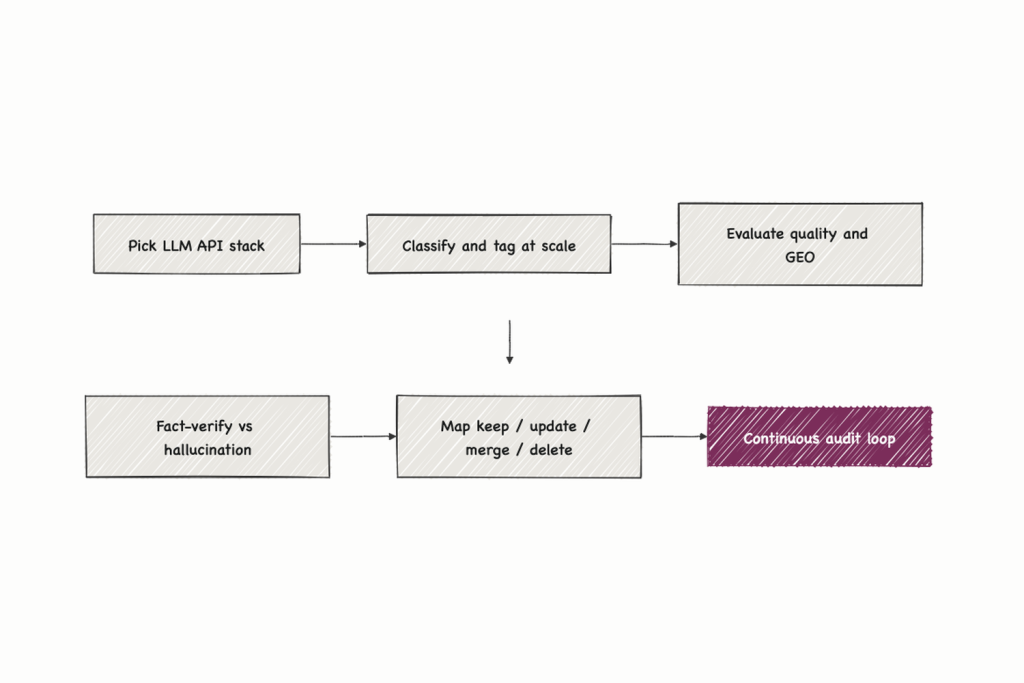
Professional SEO audit services provide the engineering-grade oversight needed to manage this content lifecycle at scale. These systems surface subtle intent shifts and internal linking gaps that manual reviews miss.
- Engineering-grade precision: automated site operators detect n-gram overlap to resolve keyword cannibalization.
- Quality signaling: regular pruning improves the site-wide quality classifier by removing thin, outdated material.
- Citation frequency: updated data keeps your pages present within the AI overview.
Treating your archive as a working laboratory, measured and pruned on a schedule, is what keeps a content library compounding instead of decaying.
Frequently Asked Questions
What is the difference between technical site health and content decay?
Technical site health focuses on the five pillars of crawlability, indexability, architecture, performance, and security that let a site render and get crawled. Content decay is the loss of utility and relevance in older pages, which can cause severe traffic loss as AI Overviews favor fresh, high-quality information. Complete SEO audit services have to address both, so the site stays functional for bots and valuable for users.
When should I choose automated auditing over manual auditing?
Automated auditing suits large-scale SEO work, where tools like Semrush can flag technical gaps and n-gram overlap across thousands of URLs quickly. Manual auditing still owns the subtle calls, such as whether to consolidate or remove a page based on specific business goals. A hybrid approach usually wins, using automation for speed and human judgment for strategy.
How do post-HCU signals change how we audit content?
After Google integrated the Helpful Content Update into its core ranking systems in March 2024, audits have to prioritize site quality over simple keyword density. Modern audits track post-HCU decay signals with n-gram phrase models, checking that content offers unique value rather than replicating patterns from known high-quality sites. In practice that means auditing for original insight, since automated classifiers reward novelty.
What is an ‘Intent Shift’ and how does it cause ranking drops?
An intent shift happens when user behavior moves from simple keyword queries toward conversational, semantic interaction driven by AI engines. A page can keep its technical health and still lose rankings if its information no longer fits the zero-click or conversational shape of modern results. That misalignment produces the “position improvement” paradox, where average position looks stable but CTR collapses because the page no longer solves the user’s specific problem.
How do I calculate the ‘Return on Refresh’ (RoR) for a project?
To calculate return on refresh, weigh the cost of updating a page against the projected content ROI from recovered traffic and lead generation. A standard decision tree (Refresh, Consolidate, Noindex, or Remove) lets teams prioritize the assets with the highest potential to regain visibility in search results. Effective SEO audit services quantify this by comparing current performance against historical peaks to find the revenue gap that decaying assets create.